
Overview
- Native to the Indo-Pacific, commonly found in deep reef slopes and lagoons.
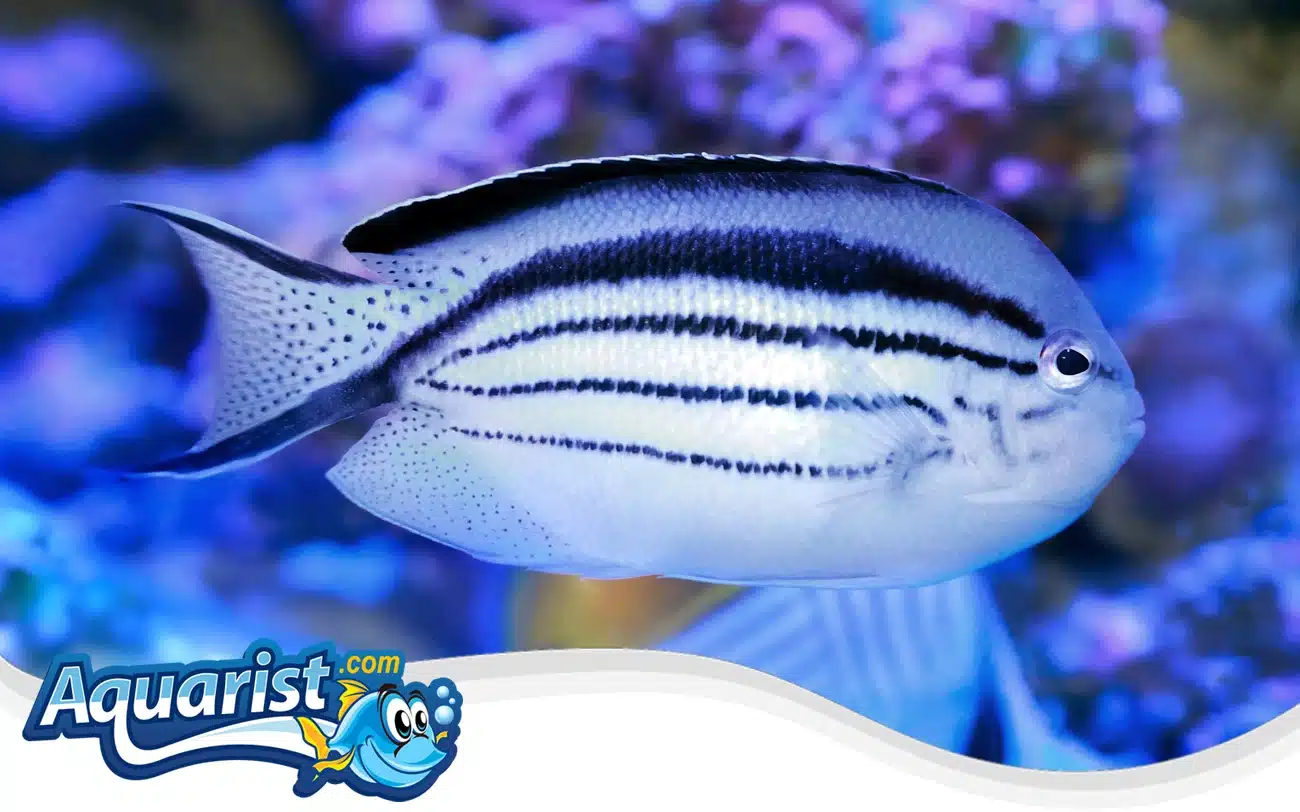
- Recognized for its elegant silver body with black horizontal stripes.
- A sexually dimorphic species, with females appearing more vibrant than males.
- Unlike many angelfish, it is planktonic rather than grazing on coral reefs.
- A peaceful species that adapts well to community aquariums.
Feeding
- Primarily feeds on zooplankton and suspended particles in the water column.
- Readily consumes high-quality flakes, pellets, frozen mysis shrimp, and brine shrimp.
- Should be fed multiple small meals daily to mimic natural feeding habits.
- Can benefit from occasional supplementation with marine algae.
- Best kept in a tank with strong water circulation to help simulate natural feeding conditions.
Habitat
- Commonly inhabits depths of 30–100 feet (9–30 m) on outer reef slopes.
- Requires an aquarium with open swimming space and moderate water flow.
- Best kept in a tank with rock structures for shelter and territories.
- Reef-safe, as it does not nip at corals, unlike other angelfish species.
- Ideal for large, well-established aquariums (minimum 125 gallons [473 L]).
Fish Care
- Optimal water temperature: 74-80°F (23-27°C).
- Ideal pH range: 8.1–8.4, with a specific gravity of 1.025–1.026 (about 33–35 ppt).
- Requires a well-maintained tank with stable water conditions.
- Highly resistant to disease when provided with a proper diet and environment.
- Can be sensitive to poor water quality, requiring regular maintenance.
Compatibility
- One of the most peaceful angelfish, suitable for community reef tanks.
- Compatible with tangs, wrasses, gobies, and other non-aggressive species.
- Best kept singly or in a bonded male-female pair to avoid territorial disputes.
- Avoid housing with overly aggressive tank mates that may stress it.
- Can coexist with larger, peaceful angelfish if the tank is spacious enough.
Aquarium Behavior
- Active swimmer, often found patrolling the mid-to-upper water column.
- Social and interactive, making it a beautiful centerpiece fish.
- Adapts quickly to aquarium life and becomes more confident over time.
- Exhibits minimal aggression, making it a great choice for mixed reef setups.
- Thrives in an environment with high oxygenation and moderate current flow.
Frequently Asked Questions
How can you tell male and female Lamarck's Angelfish apart?
It is one of the few angelfish where the sexes look different. Both are silvery gray with black stripes, but the female's stripes are bolder, and one of them runs along the edge of her tail.
How big does a Lamarck's Angelfish get?
Plan for about 8 in (20 cm).
What size tank does a Lamarck's Angelfish need?
At least 125 gallons (473 L), with plenty of open water. It is an active swimmer that spends much of its time in midwater.
What does a Lamarck's Angelfish eat?
It is an omnivore. In the wild it feeds on plankton in midwater. In the tank, feed mysis or frozen shrimp, spirulina, marine algae and good angelfish foods.
Is the Lamarck's Angelfish reef safe?
Yes. Genicanthus angelfish feed on plankton rather than grazing on corals, which makes them among the most reef-friendly angelfish.
What makes Genicanthus angelfish different?
They are the only angelfish that specialize in eating zooplankton. That is why they swim in open water and leave corals alone.
Can I keep more than one Lamarck's Angelfish?
Keep only one male per tank. In the wild they form harems of 3 to 7 fish, so a male with one or more females can work in a large aquarium.
Is the Lamarck's Angelfish aggressive?
It is peaceful. It may chase small, calm plankton eaters like anthias, fairy wrasses and fire gobies, but it usually ignores other fish, including other angelfish.
Is the Lamarck's Angelfish easy to keep?
It is easier to keep than many angelfish. It still needs a large, well-maintained tank and stable water.
What is another name for the Lamarck's Angelfish?
It is also called the Freckletail Lyretail Angelfish, after the black freckles on its tail.