
Overview
- Found in the warm waters of the Caribbean, particularly around coral reefs and rocky coastal areas.
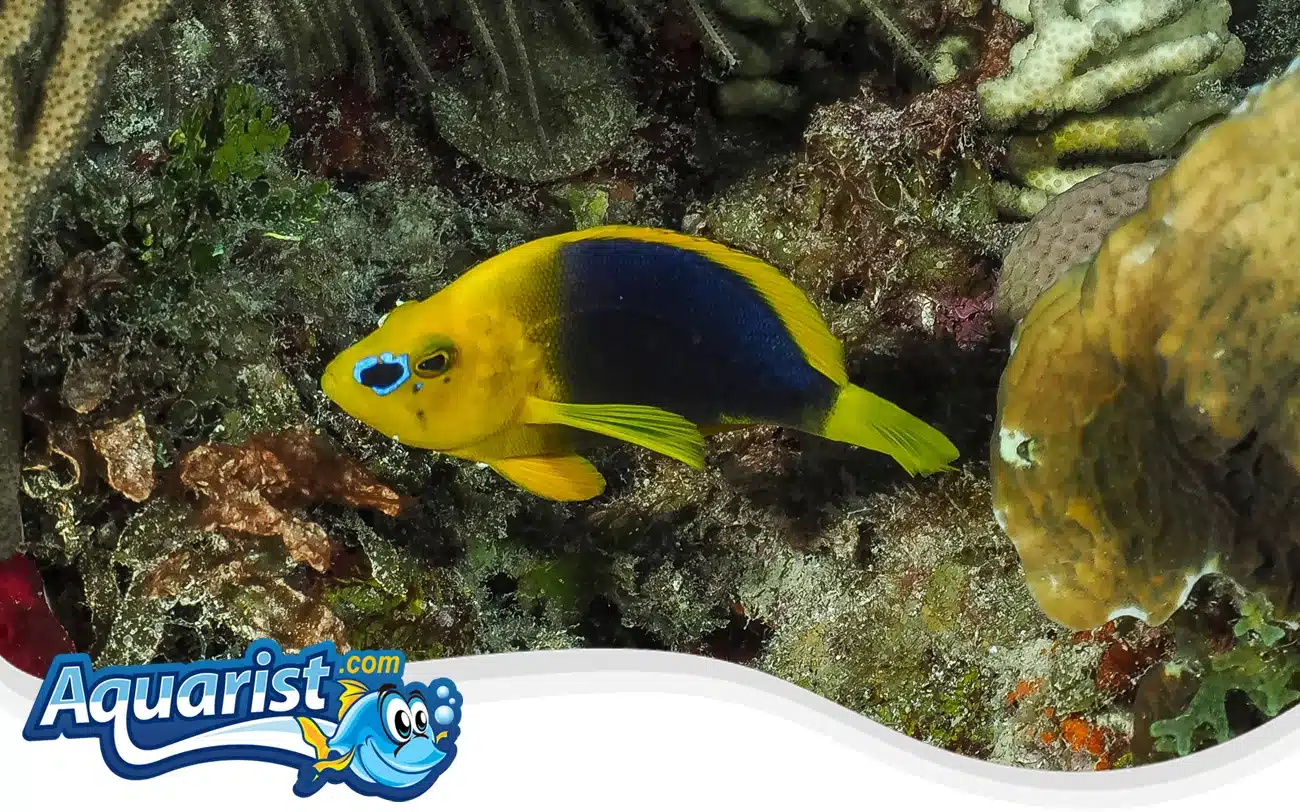
- Easily identifiable by the distinctive dark saddle-like markings along its dorsal region.
- A relatively small yet assertive species, often seen patrolling its territory.
- Best suited for reef tanks with plenty of crevices and hiding spaces.
Feeding
- Primarily carnivorous, feeding on small crustaceans, zooplankton, and tiny reef-dwelling invertebrates.
- Accepts frozen mysis shrimp, enriched brine shrimp, and high-protein pellets in captivity.
- Providing a varied diet supports both health and vibrant coloration.
- Feeding twice daily ensures steady energy levels and natural hunting behavior.
Habitat
- Prefers reef structures with abundant hiding places such as caves and ledges.
- Adapts well to aquariums that mimic natural reef formations with live rock.
- Requires moderate water movement to simulate its native habitat.
- Thrives in a well-maintained tank with stable conditions.
Fish Care
- Optimal water temperature: 74-80°F (23-27°C).
- pH level: 8.1-8.4, with a specific gravity of 1.023-1.026.
- Resilient but benefits from consistent water quality and regular maintenance.
- Acclimates best in established aquariums with minimal fluctuations in parameters.
Compatibility
- Semi-aggressive; can be territorial towards similar-sized fish.
- Best housed with equally assertive tank mates such as wrasses, dwarf angelfish, and larger clownfish.
- Should not be housed with overly timid species that may be outcompeted for food.
- Does well in a reef tank but may nip at very small shrimp or slow-moving invertebrates.
Aquarium Behavior
- Frequently seen darting among rock crevices and patrolling its designated territory.
- May exhibit dominance displays, especially if kept with other hamlets, so keep one per tank.
- Becomes more active and confident as it acclimates to its surroundings.
- Enjoys perching on rock formations while observing its environment.
Frequently Asked Questions
Is this fish a basslet?
No. Hypoplectrus guttavarius is the Shy Hamlet, a small predatory sea bass in the family Serranidae.
How big does the Shy Hamlet get?
About 5 in (13 cm).
What size tank does a Shy Hamlet need?
At least 30 gallons (114 L), with plenty of rock caves and crevices.
What does the Shy Hamlet eat?
It is a carnivore that feeds on crustaceans and small fish. Offer mysis, brine shrimp, squid, clam and other chopped seafood once or twice a day.
Is the Shy Hamlet reef safe?
With caution. It leaves corals alone but will eat small shrimp, crabs and tiny fish.
Is the Shy Hamlet aggressive?
It is semi-aggressive and territorial toward other hamlets, so keep just one per tank.
What does the Shy Hamlet look like?
It has a yellow head and fins with a large dark blue to black area on the body, and a blue-ringed black spot on its snout.
Where is the Shy Hamlet found?
In the Western Central Atlantic, including Florida, the Bahamas, the Cayman Islands, the Greater and Lesser Antilles and Honduras.
Why is it called shy?
It tends to stay close to the reef and retreats into cover when disturbed, so it needs plenty of hiding places to feel secure.
Is the Shy Hamlet hardy?
It is fairly hardy once settled, but it can be sensitive to shipping and acclimation, so buy a young specimen and move it as little as possible.