
Overview
- Native to the Indo-Pacific, frequently found in shallow lagoons, coral reefs, and seagrass beds.
- Recognized by its unique reticulated pattern, with a combination of dark and light patches across its body.
- A hardy and adaptable species that thrives in a variety of reef environments.
- Can be territorial, especially as it matures, making careful tankmate selection crucial.
- Best suited for aquariums with stable water conditions, live rock formations, and ample swimming space.
Feeding
- Omnivorous, feeding on plankton, algae, and small invertebrates in the wild.
- Thrives on a diet of high-quality marine flakes, frozen mysis shrimp, brine shrimp, and algae-based foods.
- Readily accepts prepared foods but benefits from occasional live or frozen food supplementation.
- Should be fed multiple times per day to maintain energy levels and promote optimal health.
- A well-balanced diet enhances coloration and supports a strong immune system.
Habitat
- Prefers reef-associated environments with moderate water flow and diverse coral structures.
- Frequently seen schooling near coral heads, branching corals, and reef outcroppings.
- Aquarium setups should include live rock for shelter and open areas for swimming.
- Requires stable water parameters and high-quality filtration to prevent stress.
- Providing shaded areas and structured environments supports natural schooling behaviors.
Fish Care
- Optimal water temperature: 74-80°F (23-27°C) to maintain health and activity.
- Preferred pH range: 8.1-8.4, with a salinity level of 1.020-1.025.
- Requires regular water changes and high-quality filtration to maintain clean water conditions.
- Reef-safe but can display territorial behavior towards smaller tankmates, particularly in confined spaces.
- Providing rock formations and coral branches helps reduce aggression by allowing fish to establish territories.
Compatibility
- Semi-aggressive and best kept with other similarly robust fish.
- Compatible with clownfish, wrasses, tangs, and other moderately tempered reef species.
- Should not be housed with timid or slow-moving fish that may become targets of aggression.
- Best kept in small groups to distribute aggression among their own species.
- Providing a well-structured environment with sufficient swimming space reduces territorial disputes.
Aquarium Behavior
- An energetic swimmer that establishes small territories around rock and coral formations.
- Frequently observed schooling in younger stages but may become more solitary or aggressive as it matures.
- More confident and less aggressive when given enough space and structured environments.
- Providing a natural reef-like setup encourages active swimming and natural social behaviors.
- Over time, it may recognize its caretaker and become more interactive, especially during feeding sessions.
Frequently Asked Questions
What other names does it have?
LiveAquaria sells it as the Two Stripe Damselfish and also lists Reticulate Dascyllus.
What does it look like?
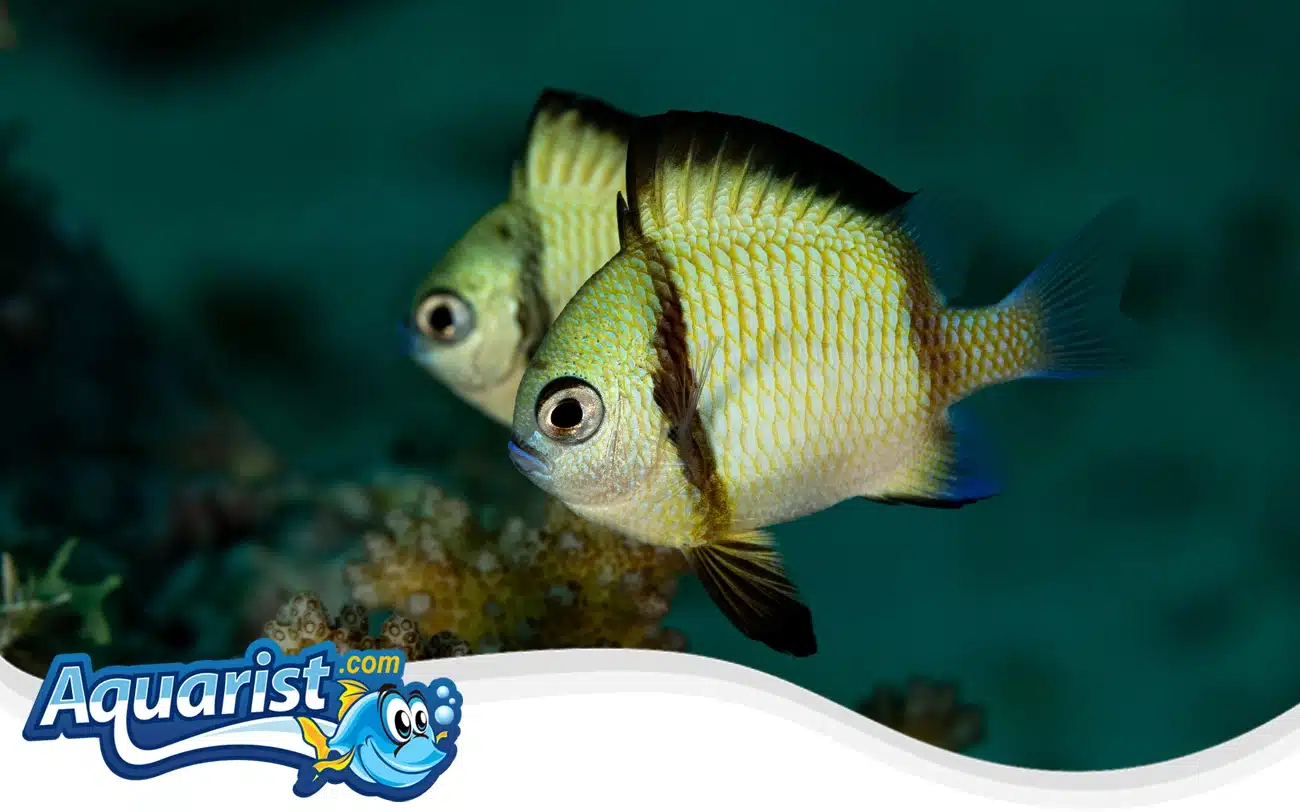
LiveAquaria describes a shimmering silver-green body with two dark bands, one at the front and one just before the blue-green tail.
How big does it get?
Our page lists about 3 in (8 cm). FishBase gives a maximum of about 3.5 in (9 cm).
What size tank does it need?
Our page recommends at least 30 gallons (114 L), which matches LiveAquaria. LiveAquaria adds plenty of hiding places.
Is it aggressive?
Our page lists it as semi-aggressive. LiveAquaria warns adults can be aggressive and suit tanks with other tough fish.
Is it reef safe?
Yes. Our page rates it reef safe, and LiveAquaria says it will not harm invertebrates or disturb the aquascape.
What is its natural habitat?
FishBase says adults live among branching coral heads, especially Pocillopora, on outer lagoon and seaward reefs, often in schools.
Where does it live in the wild?
FishBase gives the Cocos-Keeling Islands east to Samoa and the Line Islands, north to southern Japan, but not Hawaii.
What should I feed it?
LiveAquaria recommends meaty foods, herbivore preparations and flakes.
How does it breed?
FishBase says the male cleans a patch of rock or coral with his mouth, the female attaches her eggs there, and pairs form to spawn.