
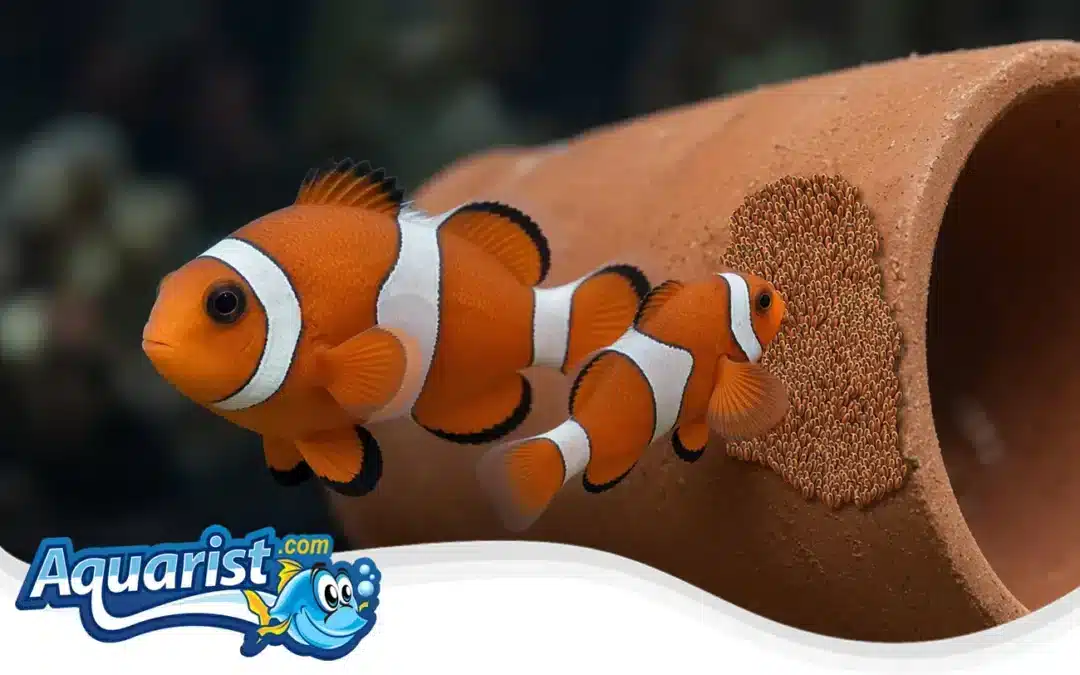
Clownfish are among the easiest marine fish to breed at home, and many reefkeepers end up with a spawning pair without trying. Getting eggs is the easy part. Raising the babies takes a second small tank, a live food culture, and about three weeks of daily work. This guide to breeding clownfish covers each stage in order: the breeding tank, the pair, water and food, spawning, the eggs, hatch night, the larval tank and metamorphosis.
The Breeding Cycle at a Glance
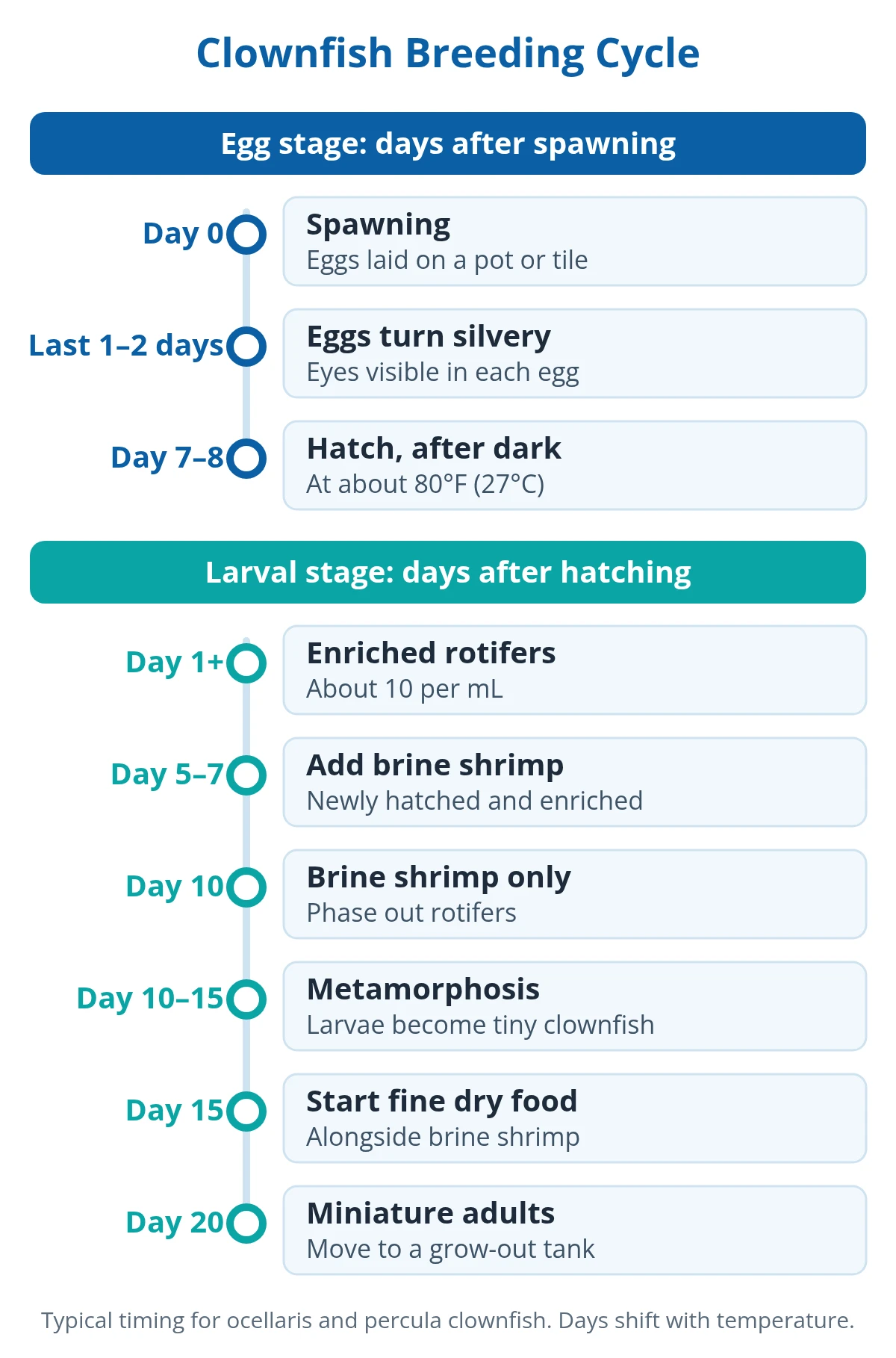
Exact days shift with temperature and species, but a typical cycle for ocellaris or percula clownfish looks like this:
| Stage | Typical timing | What to do |
|---|---|---|
| Spawning | Day 0 | Note the date and time in your log |
| Eggs turn silvery | Last day or two before hatch | Check the rotifer culture and larval tank are ready |
| Hatch | About 7 to 8 days after spawning at around 80°F (27°C) | Move the eggs to the hatching tank (or straight into the larval tank) shortly before lights out |
| Rotifers | From the first day after hatching | Keep about 10 per mL; daily 10 to 20% water changes from day 2 |
| Brine shrimp added | About day 5 to 7 | Feed newly hatched, enriched Artemia alongside rotifers |
| Brine shrimp only | About day 10 | Phase out rotifers |
| Metamorphosis | About day 10 to 15 | Start offering fine dry food from around day 15 |
| Juveniles | About day 20 onward | Move to grow-out with a sponge filter; sort by size |
Hatch is counted from spawning; later days are counted from hatching.
Setting Up a Clownfish Breeding Tank
A 20 to 30 gallon (76 to 114 L) tank is a good size for a breeding pair of clownfish. Keep the filtration gentle. There is no single correct light schedule for a breeding pair; consistency matters more than the exact hours.
Breeding kit checklist
- A reliable heater and a thermometer. Stable temperature matters at every stage, so check the thermometer daily rather than trusting the heater's dial.
- A spawning surface. A terracotta flower pot laid on its side or a ceramic tile leaned against the glass is the standard choice.
- An air pump and air stones, for the hatching and larval tanks.
- A separate larval tank, set up before the first hatch.
- A refractometer and test kits for ammonia, nitrite, nitrate and pH.
- A rotifer culture, started several weeks before the first hatch, plus a backup.
Tank Size
Smaller species such as the ocellaris clownfish (Amphiprion ocellaris) and the percula clownfish (A. percula) will breed in tanks as small as 10 gallons (38 L), but a small tank gives you less room for error. Temperature, salinity and nitrate all move faster in a small volume, so you need to test and change water more often.
Footprint matters too. A 20-gallon (76 L) high (20H) saves shelf space, while a 20-gallon (76 L) long (20L) has more surface area for gas exchange. Breeders running many pairs sometimes use small tanks plumbed into one shared system, which keeps conditions steady across all of them.
Filtration
A sponge filter is the usual choice for a dedicated pair tank: it gives good biological filtration, the flow is soft, and it can't suck up eggs. A sump is a good option if you want more water volume and somewhere to hide equipment. A protein skimmer isn't essential in the breeding tank itself, but it is useful if the tank runs on a sump. Some breeders add porous ceramic filter media alongside live rock in the broodstock sump for extra biological capacity.
Whatever you use, a well-conditioned pair eats a lot, and that food has to go somewhere. Regular water changes and siphoning uneaten food are what keep nitrate down.
Lighting
Any ordinary aquarium light, including a basic LED on a timer, is enough, and a steady 12 to 14 hour day works well. The timer matters more than the fixture, because pairs tend to settle into a regular spawning rhythm when the day length doesn't change.
Spawning Surfaces
A pot or tile is easy to lift out with the eggs attached. Pairs will also spawn on rock, shells, powerheads or the glass, which makes the eggs much harder to move, so offer a pot or tile from the start and keep it near where the pair already spends its time.
Choosing a Breeding Pair
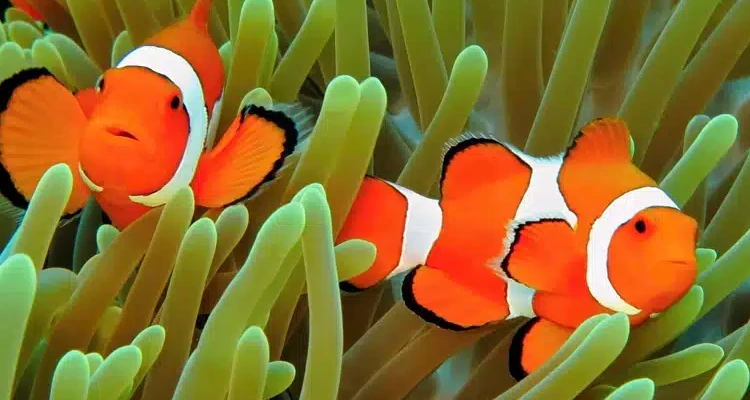
Clownfish are protandrous hermaphrodites. Every clownfish matures as a male first, and the dominant fish in a group can later turn into a female. Clownfish normally reach sexual maturity at about 9 to 15 months. Even so, two juveniles put together often take a year or two to start spawning, while an established adult pair can spawn much sooner.
How Clownfish Sex Works
Pairing is simple: put two young clownfish together and, over time, the larger one usually becomes the female and the smaller one stays male. In an established pair the female is almost always the larger, dominant fish.
The change from male to female is generally considered permanent. If the female dies, the male changes sex over about 2 to 3 months, and a younger fish can take the male role.
Females are usually the more aggressive of the two, especially toward other clownfish and anything near the nest. The male shows submission by turning on his side and quivering in front of her. Seeing that behavior is a good sign that the pair has sorted out who is who.
Captive-bred fish are the better choice for breeding. They adapt to aquarium life more easily, and you can pick fish with good body shape and no visible deformities.
Age and Maturity
Because new pairs can take a year or two to spawn, buying a proven pair costs more but saves a lot of waiting.
A bonded pair and a spawning pair aren't the same thing. Two fish can settle together within days or weeks and still take many months to spawn. How long it takes depends on the species, the age and size of the fish, and how well the tank and diet are set up.
Signs of a Bonded Pair
A bonded pair stays close together most of the day. They swim side by side, rest in the same spot at night, and defend one area of the tank, whether that's a host anemone, a pot or a corner of rock. A host anemone isn't needed for breeding. The male's sideways quivering toward the female is the clearest sign the pair is settled.
Water Parameters for Breeding
For temperature, salinity and pH, keeping the water steady matters more than hitting an exact number. Ammonia and nitrite must read zero in the breeding tank. The larval tank is filled with water from the broodstock tank so the temperature and salinity match.
Water parameters at a glance
| Parameter | Broodstock tank | Larval tank |
|---|---|---|
| Temperature | About 79 to 82°F (26 to 28°C); swings under about 2°F (1°C) a day | Same as the broodstock tank, ideally within about 79 to 82°F (26 to 28°C) |
| Specific gravity | 1.023 to 1.026 (roughly 31 to 35 ppt), kept steady | Same water as the broodstock tank |
| pH | 8.0 to 8.4, kept steady | Slightly lower is normal, as long as it stays steady |
| Ammonia and nitrite | 0 | Ammonia 0; test every day |
| Nitrate | Under 20 ppm, lower if you can | No separate figure; the daily water changes keep it down |
| Water changes | Regular | About 10 to 20% daily from day 2, with matched saltwater |
| Light | Steady 12 to 14 hour day | Dim light on 24 hours a day through the rotifer stage |
Temperature
Clownfish are often kept at 75 to 80°F (24 to 27°C) in a mixed reef. Many breeders keep pairs at about 79 to 82°F (26 to 28°C); slightly warmer water can increase spawning frequency, but stability matters more than the exact number. Avoid swings of more than about 2°F (1°C) in a day.
For the larval tank, use the same temperature as the broodstock tank, ideally within about 79 to 82°F (26 to 28°C), so the larvae never face a sudden change. Within that range, warmer water speeds up larval development a little and cooler water slows it.
Salinity
Keep the breeding tank at normal seawater salinity, a specific gravity of about 1.023 to 1.026 (roughly 31 to 35 ppt), and keep it steady. Use the same water for the hatching and larval tanks so the eggs and larvae never face a salinity change. Measure with a calibrated refractometer, and top off evaporation with fresh RO/DI water daily so the salinity doesn't creep up.
pH
Aim for a pH of 8.0 to 8.4 in the broodstock tank. A steady reading is worth more than chasing an exact number. Larval tanks often run slightly lower in pH than the display; that is normal, as long as it stays steady.
Ammonia, Nitrite and Nitrate
Keep nitrate under 20 ppm, and lower if you can manage it with regular water changes. High nitrate won't kill adult clownfish quickly, but it may hold back spawning and egg quality.
In the larval tank, keep ammonia at zero. Any detectable reading in a larval tank means a water change is due right away. Ammonia is more toxic at higher pH and temperature, but that is a reason to test often, not permission to let it build up.
Feeding a Breeding Pair
A well-fed female produces more eggs and better ones, so conditioning a pair is mostly about diet. Feed two to three small meals a day, giving only what the pair finishes in a couple of minutes.
What to Feed
Good staples are:
- Frozen mysis shrimp, krill and cyclops
- A good-quality marine pellet sized for the fish
- Live or enriched brine shrimp as an occasional treat
Rich foods such as squid and mussel, and frozen foods soaked in a fatty acid (HUFA) and vitamin supplement, help condition the female for egg production. Clownfish are omnivores, so a little nori or other marine algae now and then is fine if your pair will eat it.
How Often to Feed
Some breeders add an extra feeding when they are trying to bring a pair into condition. The fish should look full-bodied but not fat. Siphon out leftovers after each meal so the extra feeding doesn't show up as nitrate.
Clownfish Spawning Behavior
The clearest sign that spawning is close is nest cleaning. An established pair usually spawns every two to four weeks, often about every two weeks, so keeping a log helps you predict the next hatch.
Signs That Spawning Is Close
A few days before spawning, the pair picks a spot, often the inside of a pot or a tile, and both fish bite at it to scrape off algae and debris. The pair also gets more territorial and chases tankmates, and sometimes your hand, away from the site.
The male often twitches or jerks his body near the female as part of courtship. The female's belly swells as she fills with eggs. Shortly before spawning, you may see her ovipositor, a small tube that protrudes from her abdomen and is used for laying eggs.
Wild clownfish often spawn on a lunar rhythm, and some aquarium pairs seem to follow one too. In a tank, though, a steady light schedule is the cue you can actually control.
Spawning and Egg Laying
The pair gives the nest a final cleaning. Then the female makes slow passes over the surface, pressing her belly against it and laying rows of sticky eggs that stick where they land. The male follows close behind and fertilizes them. Spawning usually takes about an hour or two.
Clownfish are creatures of habit. Pairs tend to spawn at about the same time of day each time. Many pairs spawn in the afternoon or early evening, though some spawn in the morning.
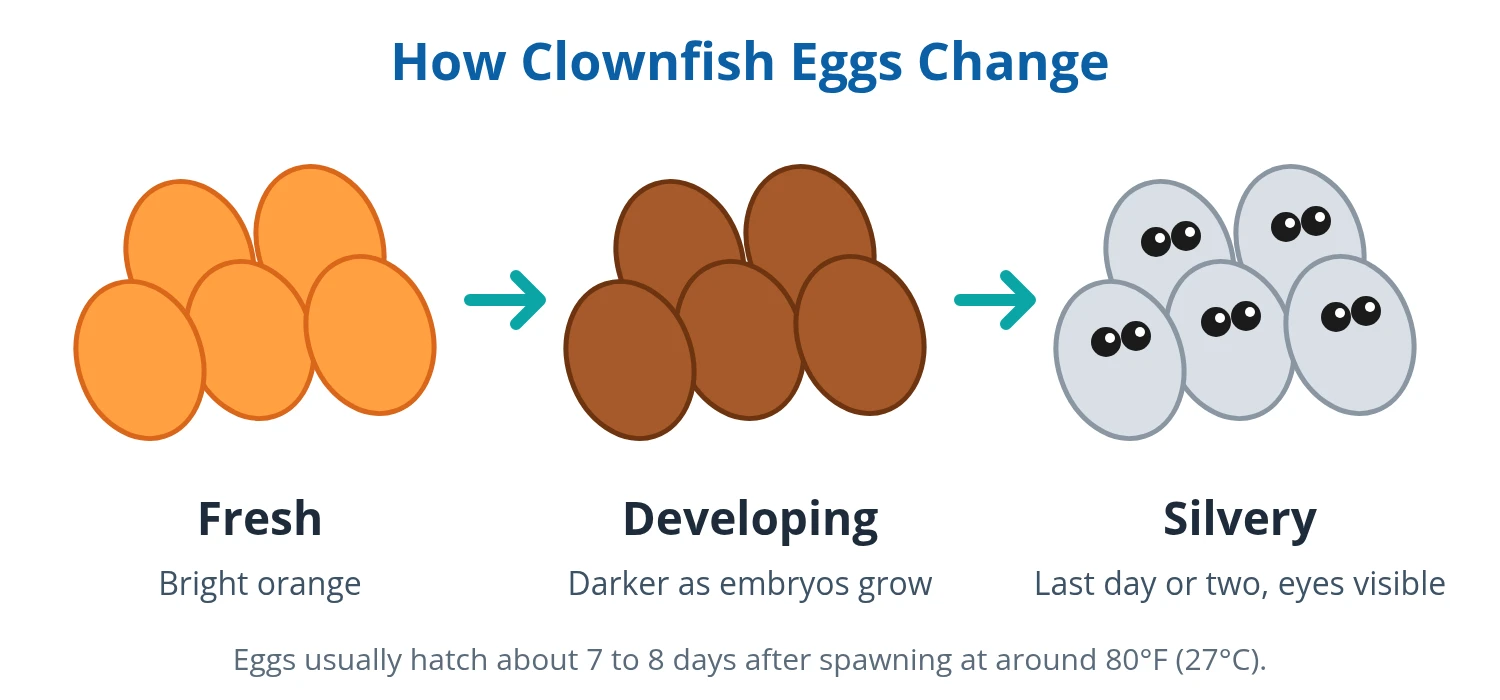
Clutch size varies with the size and age of the female. First clutches are often a couple of hundred eggs or fewer, and large, mature females commonly lay several hundred. Fresh eggs are orange. As the embryos develop they turn darker, and in the last day or two they look silvery, because the larvae's eyes show through the shell.
Caring for Clownfish Eggs
Leaving the eggs with the parents until hatch night usually gives the best hatch, because the male fans and cleans them. Eggs usually hatch about 7 to 8 days after spawning at around 80°F (27°C). Moving the eggs on hatch evening lets you collect the larvae before the parents or the filtration take them.
Hatch-night checklist
- The eggs look silvery, and your log puts you at about day 7 to 8 at around 80°F (27°C), or 9 or 10 in cooler water.
- The rotifer culture is running, with a backup, and you have rotifer enrichment ready.
- The hatching or larval tank is filled with water from the broodstock tank, with an air stone ready.
- Shortly before lights out, move the pot or tile in a bucket of tank water, keeping the eggs under water the whole time.
- Place the air stone just below the eggs, with enough bubbles to keep them gently moving.
- Turn the lights off and leave the room. Hatching starts after dark, usually within an hour or two of lights out.
- Once they have hatched, switch to the dim, always-on light. Start adding rotifers the next morning.
- Eggs on rock or glass: Turn off pumps and the skimmer on hatch night, wait until they have hatched, then shine a dim flashlight into one corner. Collect the larvae with a small cup or by siphoning gently with airline tubing, keeping them in water at all times. Turn the pumps and skimmer back on as soon as you've finished, so the display doesn't run short of oxygen.
Why Breeders Move the Eggs
The male does most of the egg care. He fans the eggs with his fins to keep fresh water moving over them, and picks out dead or unfertilized eggs before fungus can spread. The female helps now and then. Moving the eggs earlier than hatch evening, or handling them roughly, can lower the hatch rate.
If you do nothing, larvae that hatch in the display are usually eaten by the parents or other fish, or lost to the filtration. That's why breeders move the eggs, or catch the larvae, on hatch night.
Hatch Timing
Eggs hatch a little sooner in warmer water and later in cooler water, where it can take 9 or 10 days. Hatching starts after dark, usually within an hour or two of lights out. Count the days from your spawning log and watch for the silvery look; that tells you hatch night is close.
Moving the Eggs to a Hatching Tank
Many breeders hatch the eggs straight into the larval tank (see Raising Clownfish Larvae below), which saves moving the larvae later. On the expected hatch evening, when the eggs look silvery, move the pot or tile to the hatching tank (or straight into the larval tank) shortly before lights out, keeping the eggs under water the whole time. Carry the pot in a bucket or container of tank water rather than lifting it out into the air.
Fill the hatching tank with water from the broodstock tank so the temperature and salinity match exactly. Place an air stone or the end of a rigid airline tube just below the eggs, with enough bubbles to keep them gently moving, the way the male's fanning does, but not so many that the water churns. Then turn the lights off and leave the room. Eggs hatch in the dark. Once they have hatched, switch to the dim, always-on light described below.
Healthy eggs left with an attentive male, or kept under gentle aeration, rarely need any treatment. Remove any white or fuzzy eggs if you can.
Catching Larvae Hatched in the Display
If the pair spawned on rock or glass and you can't move the eggs, you can still collect larvae. Turn off pumps and the skimmer on hatch night, wait until they have hatched, then shine a dim flashlight into one corner. Newly hatched larvae swim toward light, so they gather where you can reach them. Collect the larvae with a small cup or by siphoning gently with airline tubing, keeping them in water at all times. Turn the pumps and skimmer back on as soon as you've finished, so the display doesn't run short of oxygen.
Raising Clownfish Larvae
This is where most first attempts fail, and the usual reason is food. Have your rotifer culture running and your larval tank set up before the eggs are due. From the second day on, do a small water change every day, about 10 to 20%, using saltwater from the broodstock tank or new saltwater matched exactly for temperature and salinity.
Larval feeding timeline
| Day after hatch | Food | Notes |
|---|---|---|
| Day 1 onward | Enriched live rotifers, about 10 per mL | Top up several times a day; you should see rotifers in the water at all times |
| Day 2 onward | Rotifers | Daily 10 to 20% water change with matched saltwater; siphon the bottom |
| About day 5 to 7 | Rotifers plus newly hatched brine shrimp | Enrich the brine shrimp |
| About day 10 | Brine shrimp alone | Phase out rotifers |
| Around day 15 | Brine shrimp plus fine dry food | Switch gradually |
| Around day 20 | Brine shrimp and fine dry food; young fish look like miniature adults | Move to a grow-out tank with a pre-cycled sponge filter, or add the sponge filter to the larval tank |
| As they grow | Small pellets and frozen foods such as cyclops and baby mysis, several times a day | Move up gradually as the fish get bigger |
Setting Up the Larval Tank
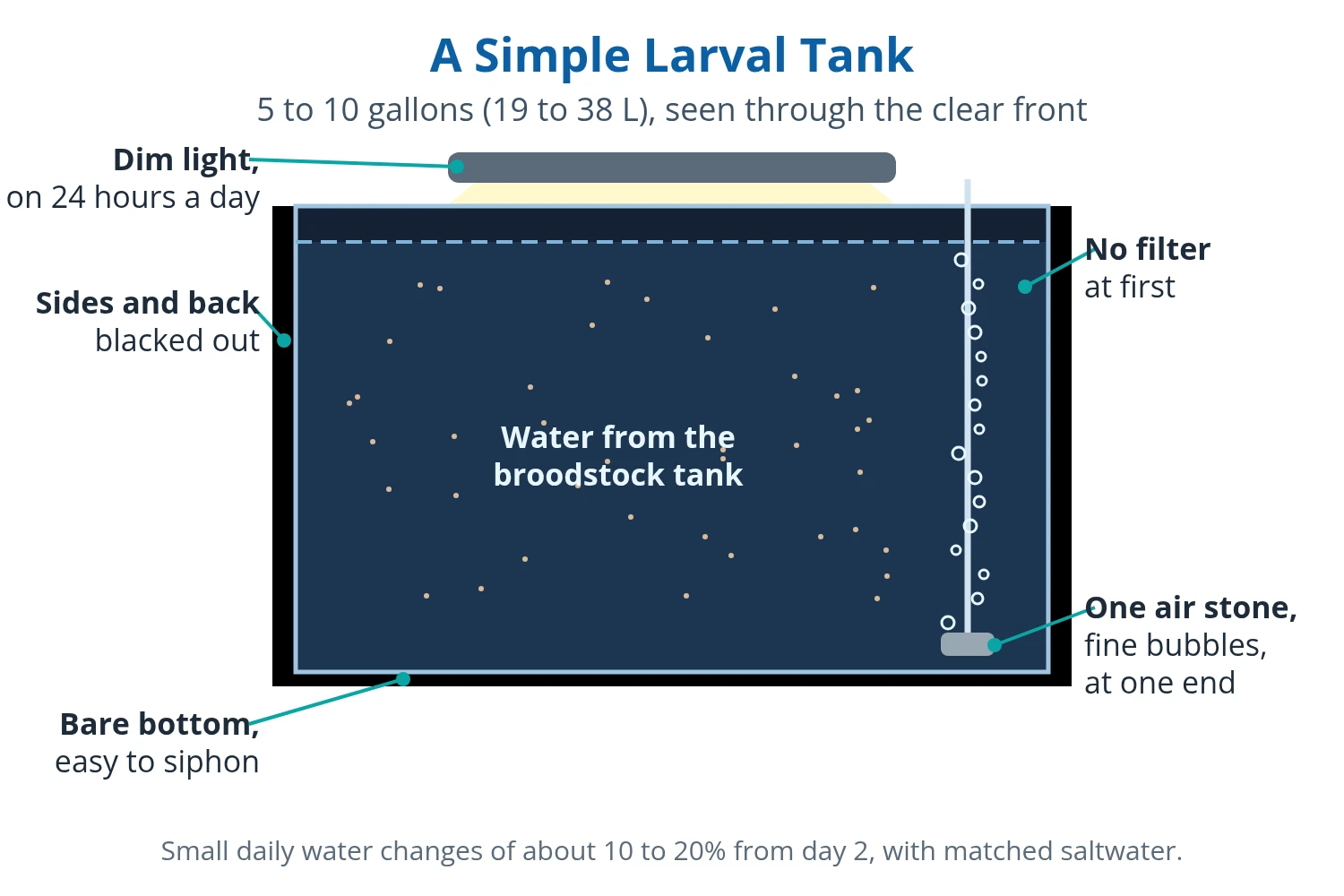
A small tank in the 5 to 10 gallon (19 to 38 L) range is ideal. A small volume keeps the rotifers concentrated, so the larvae run into food often. Some breeders start in tanks as small as 2.5 gallons (9.5 L). Fill it with water from the broodstock tank so the temperature and salinity match.
Black out the sides and back with black paper, paint or foil, and leave the front clear so you can watch. Many breeders also black out the bottom. The dark background makes the rotifers easier for the larvae to see. Keep the bottom bare so it is easy to siphon.
Use a single air stone with fine bubbles at one end of the tank for oxygen and gentle circulation, and no filter at first. Newly hatched larvae are sensitive to bright light, so keep a dim light on 24 hours a day through the rotifer stage to help them find food without stressing them.
First Food: Rotifers
Live rotifers (Brachionus) are the standard first food, because newly hatched clownfish are too small to handle brine shrimp or dry food at first. Start your rotifer culture several weeks before the first hatch, so you have time to get the culture stable and set up a backup. Cultures crash, especially new ones, and a second culture is cheap insurance.
Rotifers are grown in food-safe buckets or jars of saltwater with gentle aeration and fed phytoplankton, often called greenwater, such as Nannochloropsis. Change part of the culture water regularly to keep it from crashing. Feed the rotifers phytoplankton or a rotifer enrichment before they go into the larval tank, and enrich brine shrimp once larvae are on them for more than a few days. Unenriched brine shrimp alone lacks the fatty acids larvae need.
If your rotifer culture runs at a lower salinity than the larval tank, acclimate the rotifers gradually before feeding them. A sudden jump of more than about 5 ppt (about 0.004 specific gravity) can stun or kill them.
From the first morning after hatching, add rotifers to the larval tank at a density of around 10 rotifers per milliliter of water, and top them up several times a day so the density stays there. You should be able to see rotifers in the water at all times. Many breeders also tint the larval tank lightly with phytoplankton. It keeps the rotifers fed and nutritious while they wait to be eaten, and gives the larvae a better background for spotting them.
Water Changes and Cleaning
Heavy feeding fouls a small tank quickly, and larvae don't tolerate poor water. Siphon the bottom gently at the same time as each water change. Use airline tubing so you can see what you're picking up, and siphon into a white bucket or container so you can spot and return any larvae you pull out by mistake.
Test ammonia every day, and change water straight away if it shows anything above zero. Leave out strong filtration for the first couple of weeks, because currents and intakes are a danger to larvae this small.
Metamorphosis and the Juvenile Stage
Clownfish larvae go through metamorphosis at around 10 to 15 days after hatching, changing from transparent, plankton-like larvae into tiny clownfish. Timing depends on the species and on temperature.
Signs of Metamorphosis
The first change is in color. The yellowish larvae turn orange, and their bodies deepen into the rounder, oval clownfish shape. The white bars come next: the head bar and then the middle bar, faint and see-through at first, with the tail bar a few days later. Behavior changes too: the larvae stop swimming near the surface and start spending more time near the bottom and the glass.
Switching to Brine Shrimp and Dry Food
From about day 5 to 7 after hatching, start adding newly hatched brine shrimp (Artemia nauplii) alongside the rotifers. By about day 10, most larvae can be fed brine shrimp alone. Once they start eating brine shrimp, their bellies turn a visible orange-pink. Enrich the brine shrimp, and don't rely on it alone for long.
Once metamorphosis is done, at around day 15, start offering a fine hatchery-grade dry food or finely crushed flakes alongside the brine shrimp. Switch gradually, because juveniles kept on brine shrimp alone for too long can suffer sudden die-offs. As they grow, move up to small pellets and frozen foods such as cyclops and baby mysis, several times a day. By around day 20 the young fish look like miniature adults. Move them to a grow-out tank with a pre-cycled sponge filter at that point, or add the sponge filter to the larval tank.
Common problems and fixes
- Losses during metamorphosis. Some deaths at this stage are normal. Keep the water clean with daily small changes, avoid sudden changes in temperature, salinity or light, and make sure food is always available.
- Shock from sudden changes. Larvae and young juveniles can go into shock and die after sudden changes, such as lights snapping on or a hard knock on the tank; hobbyists sometimes call this "sudden fright syndrome." Use a dimmer or ramp-up light, or turn on a room light first, and move slowly around the tank.
- Larvae not eating. Usually the rotifers are too thin, or not enriched. Check that you can see rotifers in the water, and that gentle aeration keeps them in suspension.
- Poor hatches. Too much handling of the eggs, too little aeration, or eggs moved too early are the usual causes.
- Aggression among juveniles. Fighting gets worse when juveniles are crowded. Give them room in the grow-out tank, and sort them by size so the biggest fish don't bully the smallest.
Once you have been through one full cycle, the rest is routine. A healthy pair will keep spawning every couple of weeks, so the real limits are how many rotifers you can grow and how much tank space you have for juveniles. It's worth sorting out where the young fish will go before you have a few hundred of them.
Clownfish Breeding FAQ
How long do clownfish eggs take to hatch?
Usually about 7 to 8 days at around 80°F (27°C). Warmer water shortens that a little, and cooler water can stretch it to 9 or 10 days. They hatch after dark, usually within an hour or two of lights out.
At what age can clownfish breed?
Clownfish normally mature at about 9 to 15 months, but a pair formed from two juveniles often takes a year or two to spawn. An established adult pair can start much sooner.
Do I need an anemone to breed clownfish?
No. Clownfish spawn readily without one. A clay pot or ceramic tile gives them a spawning site and lets you move the eggs on hatch night.
How often do clownfish spawn?
An established pair usually spawns every two to four weeks, often about every two weeks, though some pairs take a break for a month or two each year. A spawning log helps you plan for each hatch.
What do baby clownfish eat?
Enriched live rotifers for the first days, then newly hatched brine shrimp from about day 5 to 7, and fine dry food from about day 15, once metamorphosis is done.
Can I let clownfish eggs hatch in my display tank?
They will hatch, but you won't raise any babies that way. Larvae that hatch in the display are usually eaten by the parents or other fish, or lost to the filtration. To raise them, move the eggs to a larval tank on hatch evening.
For reference only. Every pair and setup is different, so test your water often, change one thing at a time, and ask an experienced breeder if you are unsure.