
Overview
- Found in the Indo-Pacific region.
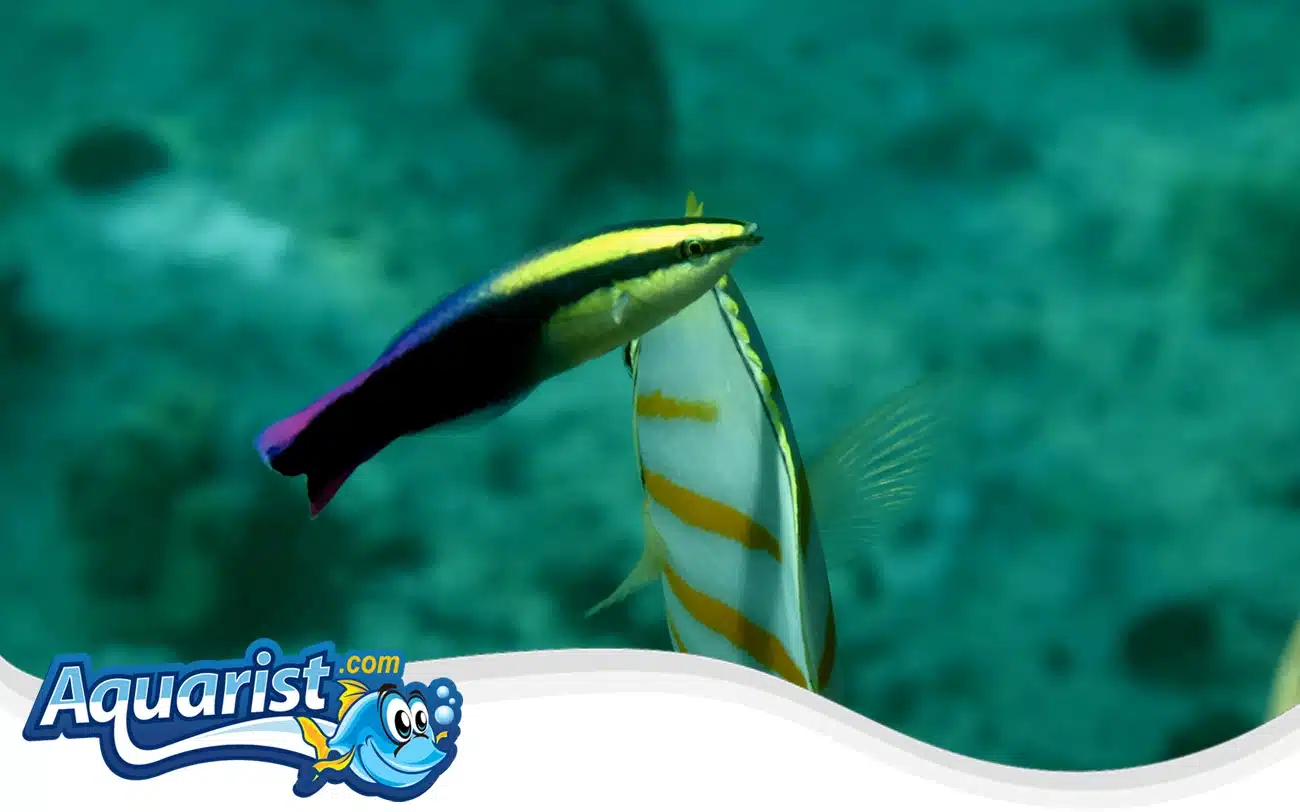
- Known for their role in cleaning other fish by removing parasites.
- They have a slender body and a distinctive swimming pattern.
- Cleaner wrasses establish cleaning stations on the reef.
Feeding
- They are primarily carnivores.
- Their diet consists of ectoparasites and dead tissue from other fish.
- Cleaner wrasses use their pointed mouths to pick parasites off their clients.
- They may occasionally consume small invertebrates.
Habitat
- Cleaner wrasses inhabit coral reefs and rocky areas.
- They prefer areas where they can establish cleaning stations.
- These fish are commonly found in tropical and subtropical waters.
- They seek out locations that are easily accessible to a variety of fish species.
Fish Care
- Maintaining stable water conditions is important for their health.
- Providing a varied diet can supplement their natural feeding habits.
- Regular water quality checks are essential for preventing illness.
- A well-established tank with plenty of live rock is beneficial.
Compatibility
- Cleaner wrasses are generally peaceful.
- They can be kept with a variety of other fish species.
- However, they may not thrive in environments where their cleaning services are not needed.
- It’s important to ensure they have access to their natural food source or a suitable substitute.
Aquarium Behavior
- Cleaner wrasses are active swimmers.
- They exhibit cleaning behavior, even in an aquarium setting.
- They often interact with other fish, attempting to clean them.
- Their presence can add interest and activity to a reef aquarium.
Frequently Asked Questions
What does a Hawaiian Cleaner Wrasse look like?
Adults are brightly colored. Juveniles look quite different, black with a broad blue stripe along the back. Males and females look the same.
How big does a Hawaiian Cleaner Wrasse get?
Plan for about 5 in (13 cm) in the aquarium. FishBase records wild fish up to about 4.7 in (12 cm).
What size tank does a Hawaiian Cleaner Wrasse need?
At least 55 gallons (208 L). It swims constantly, so give it open space and other fish to clean.
Should I buy a captive-bred Hawaiian Cleaner Wrasse?
Yes, if you can find one. CORAL Magazine reports that captive-bred fish readily eat enriched brine shrimp, frozen Cyclop-eeze, weaning diets and even flakes. Wild fish have long been hard to feed.
What does a Hawaiian Cleaner Wrasse eat?
It is a carnivore. In the wild it picks parasitic crustaceans, mucus and some scales off other fish. Its scientific name means louse eater. Feed small meaty foods several times a day.
Is the Hawaiian Cleaner Wrasse reef safe?
With caution. It doesn't eat corals, but it relies on other fish for part of its food, so it needs a busy, peaceful tank.
Is the Hawaiian Cleaner Wrasse aggressive?
No, it is peaceful. Quality Marine notes it can be territorial toward fish that look like it.
Does the Hawaiian Cleaner Wrasse bury itself at night?
No. Unlike most small wrasses, it rests on the bottom inside a mucus cocoon, similar to a parrotfish.
Where does the Hawaiian Cleaner Wrasse live in the wild?
It is found only in the Hawaiian Islands, Midway Atoll and Johnston Atoll. It lives in most coral reef habitats down to about 400 ft (122 m), and adult males patrol territories that include several females' cleaning stations.
Is the Hawaiian Cleaner Wrasse good for beginners?
No, it is an advanced fish. Wild fish often waste away even when they appear to eat, so captive-bred fish are by far the better choice.