
Overview
- Native to the Indo-Pacific, commonly found in coral reefs, rocky overhangs, and coastal lagoons.
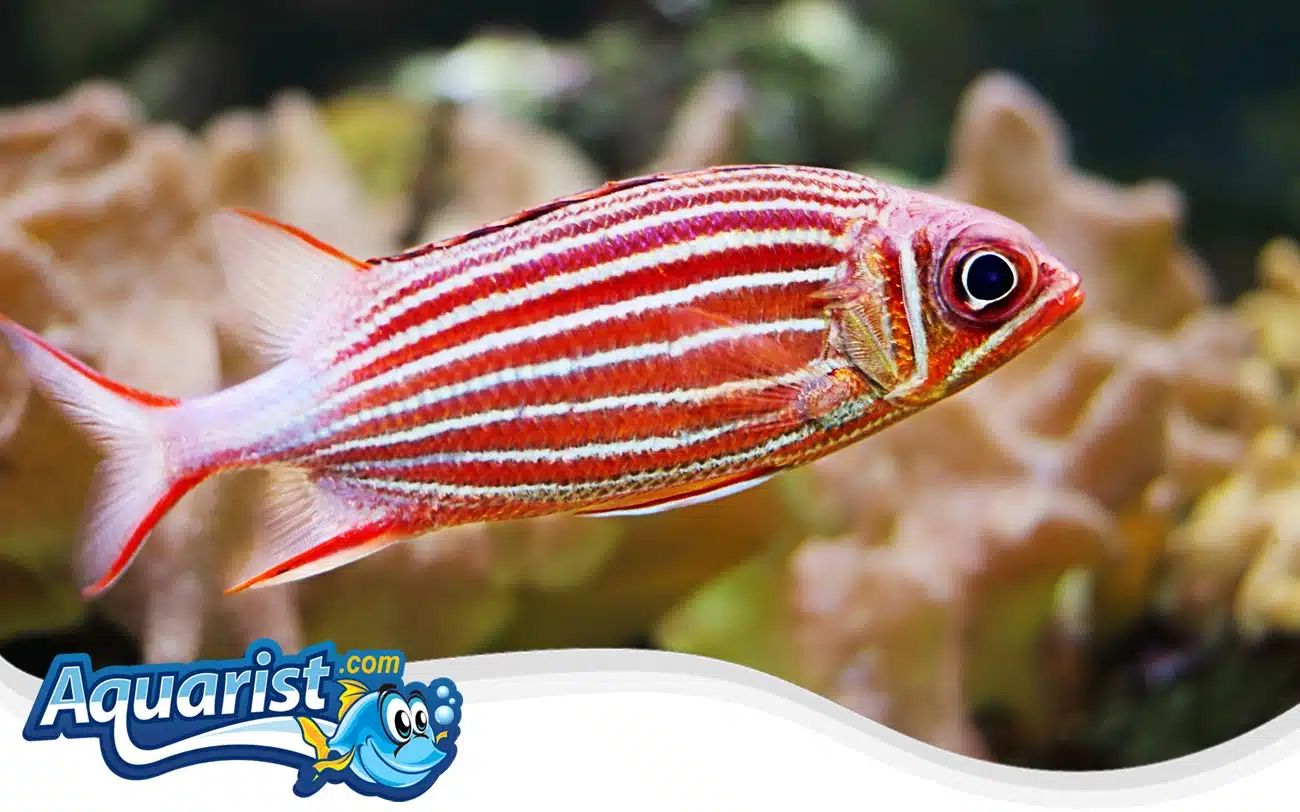
- Easily recognized by its bright red body, white horizontal stripes, and large, reflective eyes.
- A nocturnal species that remains hidden during the day and becomes more active at night.
- Has a peaceful temperament but may show slight territorial behavior around its chosen hiding spots.
- Best suited for aquariums with ample caves, rock formations, and subdued lighting.
Feeding
- Carnivorous, primarily feeding on small crustaceans, worms, and zooplankton in the wild.
- Thrives on a diet of frozen mysis shrimp, brine shrimp, finely chopped seafood, and high-quality marine pellets.
- Readily accepts prepared foods but benefits from occasional live food supplementation.
- Should be fed in the evening or at night to mimic natural feeding habits.
- A varied diet ensures proper nutrition, strong immune function, and vibrant coloration.
Habitat
- Prefers reef-associated environments with shaded areas and rock crevices for hiding.
- Frequently found in caves or under ledges during daylight hours, emerging at night to forage.
- Aquarium setups should include live rock structures to provide shelter and security.
- Requires stable water parameters and a high-quality filtration system to maintain water quality.
- Providing dim lighting or shaded regions helps support its nocturnal nature.
Fish Care
- Optimal water temperature: 74-80°F (23-27°C) to support overall health.
- Preferred pH range: 8.1–8.4, with a salinity level of 1.025–1.026 (about 33–35 ppt).
- Requires regular water changes and consistent maintenance to prevent stress-related illnesses.
- Reef-safe but may consume very small ornamental shrimp and delicate invertebrates.
- Providing a structured environment with hiding spots helps reduce stress and encourage natural behaviors.
Compatibility
- Generally peaceful but may become territorial around its preferred hiding places.
- Compatible with clownfish, tangs, wrasses, and other reef-safe species.
- Should not be housed with highly aggressive fish that may harass or stress it.
- Best kept in tanks where it has adequate hiding spaces and is not outcompeted for food.
- Providing a well-structured aquarium with sufficient caves minimizes territorial disputes.
Aquarium Behavior
- A nocturnal species, often seen hiding in rock crevices or under coral ledges during the day.
- Frequently emerges at night to actively forage for food.
- More confident in a well-established aquarium with plenty of secure hiding areas.
- Providing a dimly lit environment encourages natural behaviors and minimizes stress.
- Over time, it may become accustomed to its caretaker and recognize feeding routines.
Frequently Asked Questions
What is another name for the Crown Squirrelfish?
It is also called the Barred Squirrelfish, and it is one of the smallest fish in its genus.
How big does a Crown Squirrelfish get?
It reaches up to about 6.7 in (17 cm), though it rarely exceeds 5 in (13 cm).
What size tank does a Crown Squirrelfish need?
At least 75 gallons (284 L), with caves big enough to hold an adult.
Is the Crown Squirrelfish reef safe?
With caution. Squirrelfish don't bother corals but will eat snails, crabs, starfish and small fish.
Is the Crown Squirrelfish nocturnal?
Yes. It hides by day and feeds at night, so a dimly lit tank or plenty of caves helps it settle.
What does a Crown Squirrelfish eat?
Offer chopped fish or shrimp, mysis, frozen brine shrimp and frozen carnivore foods, once or twice a day.
How do I get a new Crown Squirrelfish to eat?
Offer live foods such as enriched brine shrimp or grass shrimp at first. It learns to take frozen mysis and krill over time.
What tankmates suit a Crown Squirrelfish?
Tankmates must be large enough not to be eaten, since it will eat smaller fish.
Can I keep Crown Squirrelfish in a group?
Yes. Small groups work well in a large enough tank, and it tends to gather in groups in the wild.
Is the Crown Squirrelfish venomous?
It has a venomous spine on its gill cover, so handle it with care.