
Overview
- Native to the Indo-Pacific, commonly found in coral reefs, lagoons, and rocky reef environments.
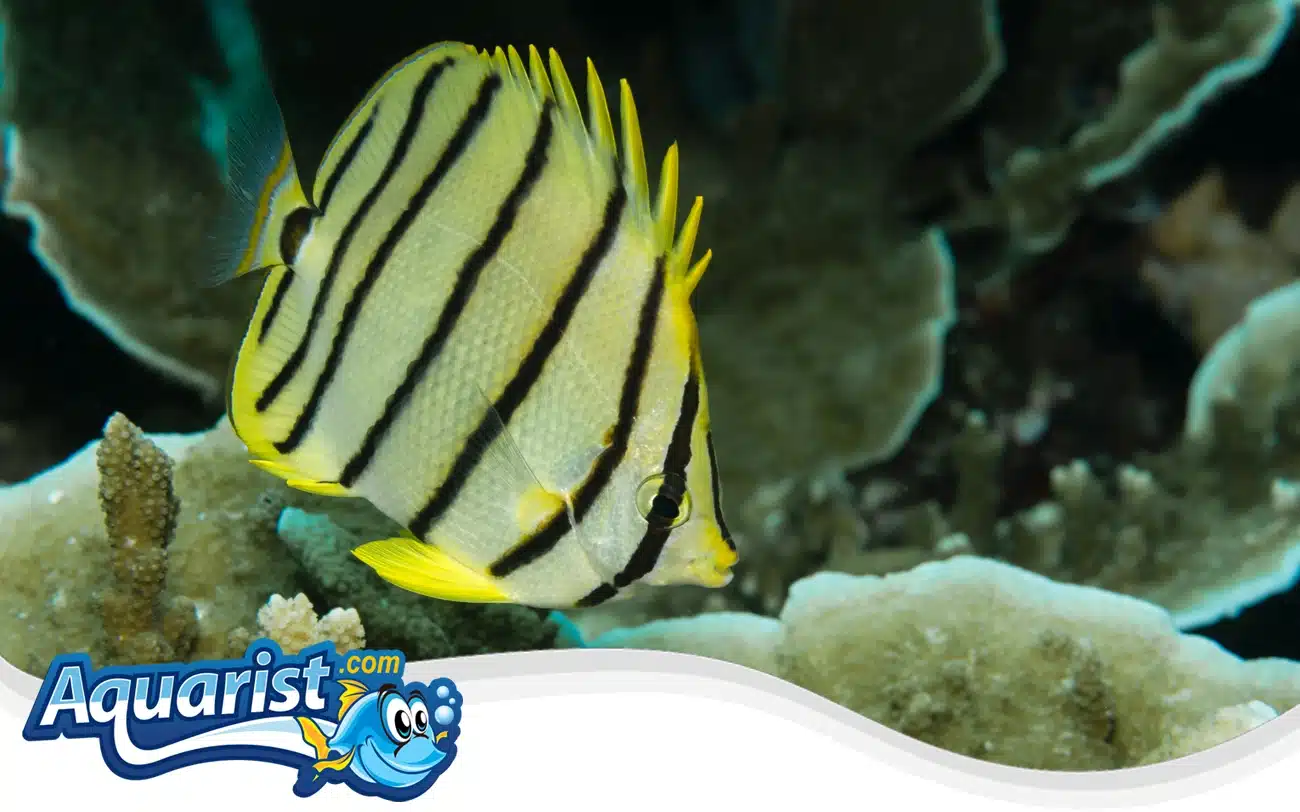
- Distinguished by its bright yellow body adorned with eight bold black vertical bands.
- A specialized species with a diet that primarily consists of coral polyps.
- Often found in pairs or small groups, particularly in areas with dense coral formations.
- Best suited for experienced aquarists due to its feeding habits and sensitivity to water conditions.
Feeding
- Obligate corallivore, feeding almost exclusively on live coral polyps in the wild.
- Requires a diet of sponge-based foods, frozen mysis shrimp, and high-quality marine algae in captivity.
- May take time to transition to prepared foods, making feeding a challenge for new keepers.
- Frequent small meals throughout the day help sustain energy levels and digestive health.
- A well-balanced diet supports strong immunity and prevents nutritional deficiencies.
Habitat
- Prefers coral-rich reef environments with moderate water movement.
- Commonly found near reef slopes and sheltered areas with abundant food sources.
- Aquarium setups should include live rock to encourage natural foraging behaviors.
- Requires excellent water quality with high filtration efficiency to prevent stress-related illnesses.
- Providing both shaded areas and open swimming space helps the fish feel secure and comfortable.
Fish Care
- Optimal water temperature: 75-82°F (24-28°C) for maintaining metabolic balance.
- Preferred pH range: 8.1–8.4, with a salinity level of 1.025–1.026 (about 33–35 ppt).
- Requires stable water parameters with frequent water changes to ensure long-term health.
- Not reef-safe due to its coral-feeding nature, making it unsuitable for reef aquariums.
- Providing live rock formations enhances its natural grazing behavior and reduces stress.
Compatibility
- Generally peaceful but may become territorial towards other butterflyfish in confined spaces.
- Compatible with tangs, wrasses, and other non-aggressive marine fish.
- Not suitable for reef tanks, as it will actively graze on coral polyps.
- Should be housed with similarly sized fish that do not pose a threat or compete for food.
- Providing ample swimming space and structured environments helps maintain a peaceful community.
Aquarium Behavior
- An active and agile swimmer that explores its environment constantly.
- Frequently observed picking at rock surfaces in search of food.
- May take time to acclimate to a new environment but becomes more comfortable over time.
- Providing live rock supports natural foraging behaviors and encourages activity.
- Over time, it may develop recognition of its caretaker and exhibit interactive behaviors during feeding sessions.
Frequently Asked Questions
What does an Eightband Butterflyfish look like?
It has a slim yellow body crossed by eight black vertical bands, counting the one through the eye. That is why it is also called the Eight Stripe Butterflyfish.
How big does an Eightband Butterflyfish get?
It is one of the smallest butterflyfish, reaching about 5 in (13 cm).
What size tank does an Eightband Butterflyfish need?
At least 75 gallons (284 L), with live rock for hiding and room to swim.
Is the Eightband Butterflyfish reef safe?
No. It feeds on coral polyps, crustaceans and Tridacna clam mantles, so it belongs in a fish-only tank.
What does an Eightband Butterflyfish eat?
In the wild it eats only coral polyps. Some will learn to take mysis and other small frozen foods, but many never do.
Why is the Eightband Butterflyfish rated advanced?
It is a strict coral eater in nature and is often reluctant to switch to prepared foods. Only buy one that is already seen eating at the store.
Why is the Eightband Butterflyfish so slim?
Its narrow, compressed body lets it slip between Acropora branches, where juveniles shelter in groups.
Is the Eightband Butterflyfish peaceful?
Yes. It is rated peaceful and is easily bullied, so pick calm tankmates.
Do Eightband Butterflyfish live in pairs?
Adults swim in pairs in sheltered, coral-rich lagoons and inshore reefs.
Where does the Eightband Butterflyfish come from?
It lives in the Indo-West Pacific, from Indonesia and the Philippines through Papua New Guinea to the Great Barrier Reef, the Solomon Islands and north to China.