
Overview
- Native to the Indo-Pacific, frequently found in coral reefs, lagoons, and reef slopes.
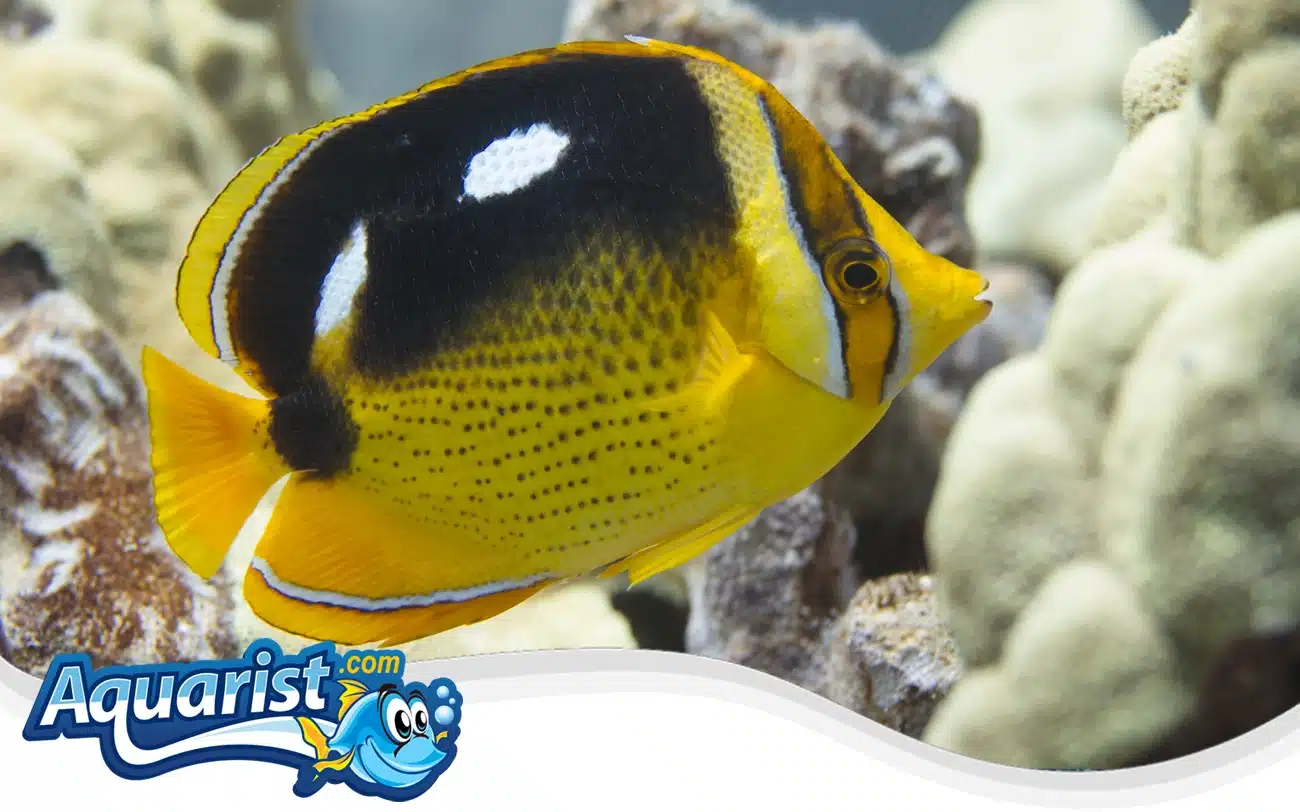
- Named for the four distinct black spots on its body, contrasting with its yellowish hue.
- A relatively hardy species that can adapt to captivity with stable water conditions.
- Often observed in pairs or small groups, particularly in coral-rich areas.
- Best suited for an aquarium with well-maintained water quality and plenty of live rock.
Feeding
- Omnivorous, feeding on coral polyps, small invertebrates, and algae in the wild.
- Requires a diet rich in sponge-based foods, frozen mysis shrimp, and marine algae in captivity.
- May take time to transition to prepared foods, but offering a varied diet improves success.
- Multiple small meals per day help support digestion and maintain energy levels.
- A balanced diet promotes bright coloration and strong immune health.
Habitat
- Prefers coral-rich reef environments with moderate water movement.
- Frequently found near reef edges and sheltered coastal areas where food is abundant.
- Aquarium setups should include live rock for natural grazing and hiding spots.
- Requires stable water parameters with strong filtration to ensure longevity.
- Providing shaded areas alongside open swimming space supports natural behaviors.
Fish Care
- Optimal water temperature: 74-80°F (23-27°C) to ensure metabolic balance.
- Preferred pH range: 8.1–8.4, with a salinity level of 1.025–1.026 (about 33–35 ppt).
- Requires regular water changes and proper tank maintenance for long-term health.
- Not completely reef-safe, as it may nip at corals and sessile invertebrates.
- Providing a structured environment with live rock supports natural foraging habits.
Compatibility
- Generally peaceful but can become territorial toward other butterflyfish.
- Compatible with tangs, angelfish, and other non-aggressive marine species.
- Not ideal for reef tanks due to its tendency to graze on coral polyps.
- Should be housed with similarly sized tankmates to prevent competition for food.
- Providing ample space and hiding areas minimizes territorial aggression.
Aquarium Behavior
- An active and curious species that enjoys exploring its surroundings.
- Frequently observed grazing on rock surfaces and interacting with other fish.
- May take time to adjust to captivity but becomes more confident with proper care.
- Providing live rock encourages natural grazing behavior and helps reduce stress.
- Over time, it may develop recognition of its caretaker and display curiosity, especially during feeding sessions.
Frequently Asked Questions
What does a Fourspot Butterflyfish look like?
It has a dark brown upper body and a yellow belly, with two white spots on its back on each side, which gives four spots in total.
How big does a Fourspot Butterflyfish get?
It reaches about 7 in (18 cm).
What size tank does a Fourspot Butterflyfish need?
At least 75 gallons (284 L) with strong water movement and open swimming room.
Is the Fourspot Butterflyfish reef safe?
It is reef safe with caution. In the wild it feeds mainly on Pocillopora coral polyps, so stony corals are at risk.
What does a Fourspot Butterflyfish eat?
Offer mysis, brine shrimp, chopped clam and marine algae several times a day. Wean it slowly from live foods to frozen.
What habitat does the Fourspot Butterflyfish prefer?
It lives almost only on exposed, surge-swept seaward reefs, so it appreciates strong water flow and plenty of oxygen.
Do Fourspot Butterflyfish live in pairs?
Yes. It is monogamous and is found alone or in pairs.
Is the Fourspot Butterflyfish peaceful?
Yes. It is rated peaceful.
Where does the Fourspot Butterflyfish come from?
It lives in the Pacific, from the Ryukyu and Bonin Islands and Taiwan to Hawaii, the Marquesas and Pitcairn.
Is the Fourspot Butterflyfish good for beginners?
It is rated intermediate. It is hardier than strict coral eaters but still needs a mature tank and patient feeding.