
Overview
- Commonly found in the Indo-Pacific region, often inhabiting coral reefs and lagoons.
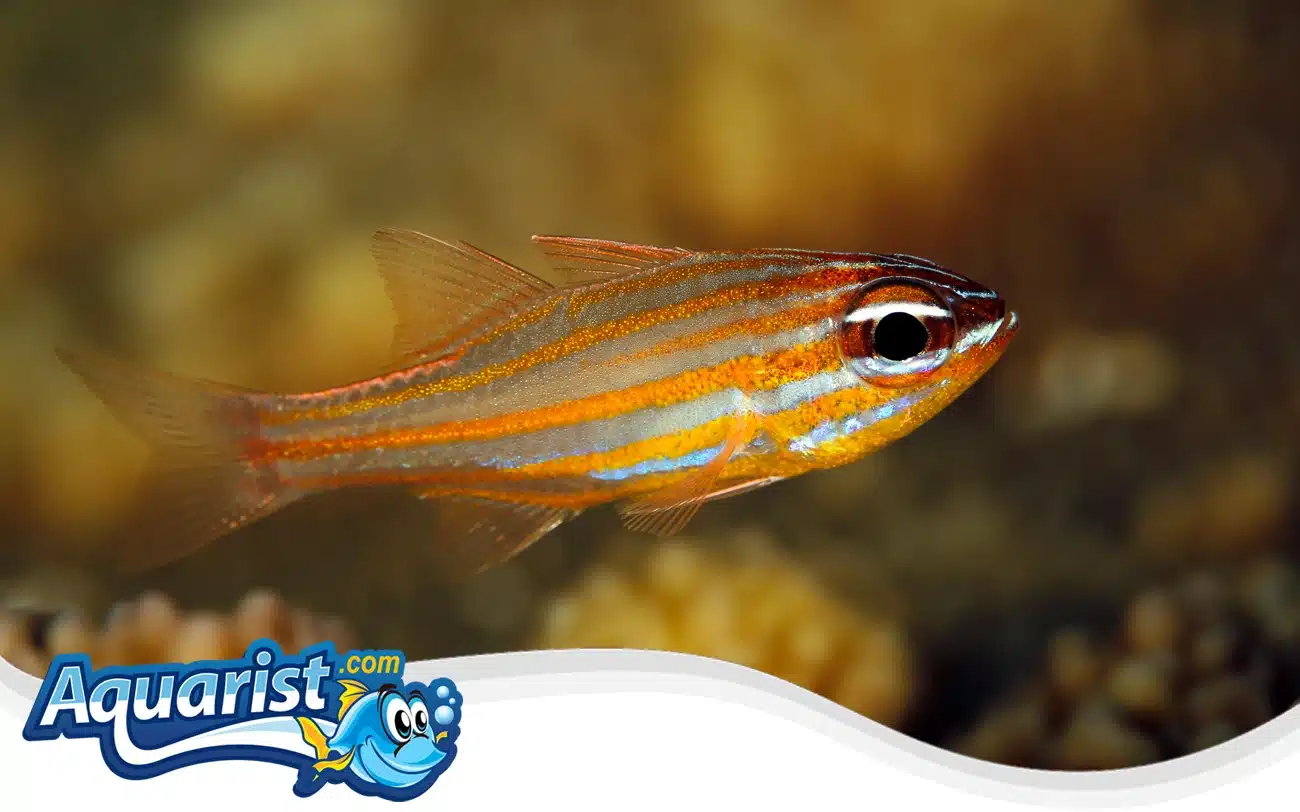
- Easily recognized by its pale body adorned with multiple yellow horizontal stripes running from head to tail.
- A nocturnal species that prefers to remain hidden during the day, becoming more active at night.
- Frequently found in small groups or pairs, sheltering among coral branches or rocky overhangs.
Feeding
- Carnivorous, primarily preying on planktonic organisms, small crustaceans, and zooplankton.
- Accepts a variety of live and frozen foods, including brine shrimp, mysis shrimp, and copepods.
- Can adapt to eating high-quality marine flakes and pellets when introduced gradually.
- Prefers multiple small meals throughout the day, especially during dimly lit periods.
Habitat
- Typically resides in coral-rich environments, hiding among branching corals and crevices for protection.
- Prefers stable water conditions with a moderate water current.
- Aquariums should include ample live rock and shaded hiding areas to create a comfortable setting.
- Thrives in reef tanks with plenty of shelter while allowing open swimming areas.
Fish Care
- Optimal water temperature: 72-78°F (22-26°C).
- Ideal pH range: 8.1–8.4, with a salinity level of 1.025–1.026 (about 33–35 ppt).
- Requires clean water conditions with strong filtration to maintain its health.
- Ammonia and nitrite levels should be kept at a minimum to prevent stress-related illnesses.
- Providing a dim environment with subdued lighting helps mimic their natural deepwater habitat.
Compatibility
- A peaceful species that thrives in community reef tanks with other non-aggressive fish.
- Compatible with tangs, gobies, wrasses, and other small to medium-sized reef-safe species.
- Should not be housed with large or aggressive fish that may see them as prey.
- Best kept in small groups or pairs, as they exhibit natural schooling behavior.
Aquarium Behavior
- Nocturnal by nature, often retreating to caves and coral crevices during daylight hours.
- Becomes more active in the evening, exploring the aquarium and searching for food.
- Forms small schools in the wild but can be kept singly or in pairs in a home aquarium.
- Providing plenty of hiding spaces and a structured tank setup encourages natural behaviors.
Frequently Asked Questions
What is an Orange-Lined Cardinalfish?
Apogon cyanosoma is a small, silvery-blue cardinalfish with thin orange lines along its body.
How big does the Orange-Lined Cardinalfish get?
It stays small, at about 3 in (8 cm).
What size tank does an Orange-Lined Cardinalfish need?
At least 20 gallons (76 L) with ledges and caves to hide under.
Is the Orange-Lined Cardinalfish reef safe?
Yes. It is fully reef safe.
What does an Orange-Lined Cardinalfish eat?
It is a carnivore. In the wild it eats plankton, so offer mysis, brine shrimp and other small meaty foods.
Is the Orange-Lined Cardinalfish peaceful?
Yes. It is peaceful and can be kept in small groups.
Where does the Orange-Lined Cardinalfish hide?
In the wild it gathers under ledges, in holes and even among the spines of sea urchins.
Is the Orange-Lined Cardinalfish good for beginners?
Yes. It is rated beginner-level and is hardy in a peaceful tank.
Can Orange-Lined Cardinalfish be bred?
Yes. It has been reared in captivity, with the male brooding eggs in his mouth.
Where does the Orange-Lined Cardinalfish come from?
It ranges across the Indo-Pacific, from the Red Sea and Persian Gulf to Fiji and Tonga.