
Overview
- Found in the Indo-Pacific, including the Great Barrier Reef and the Philippines.
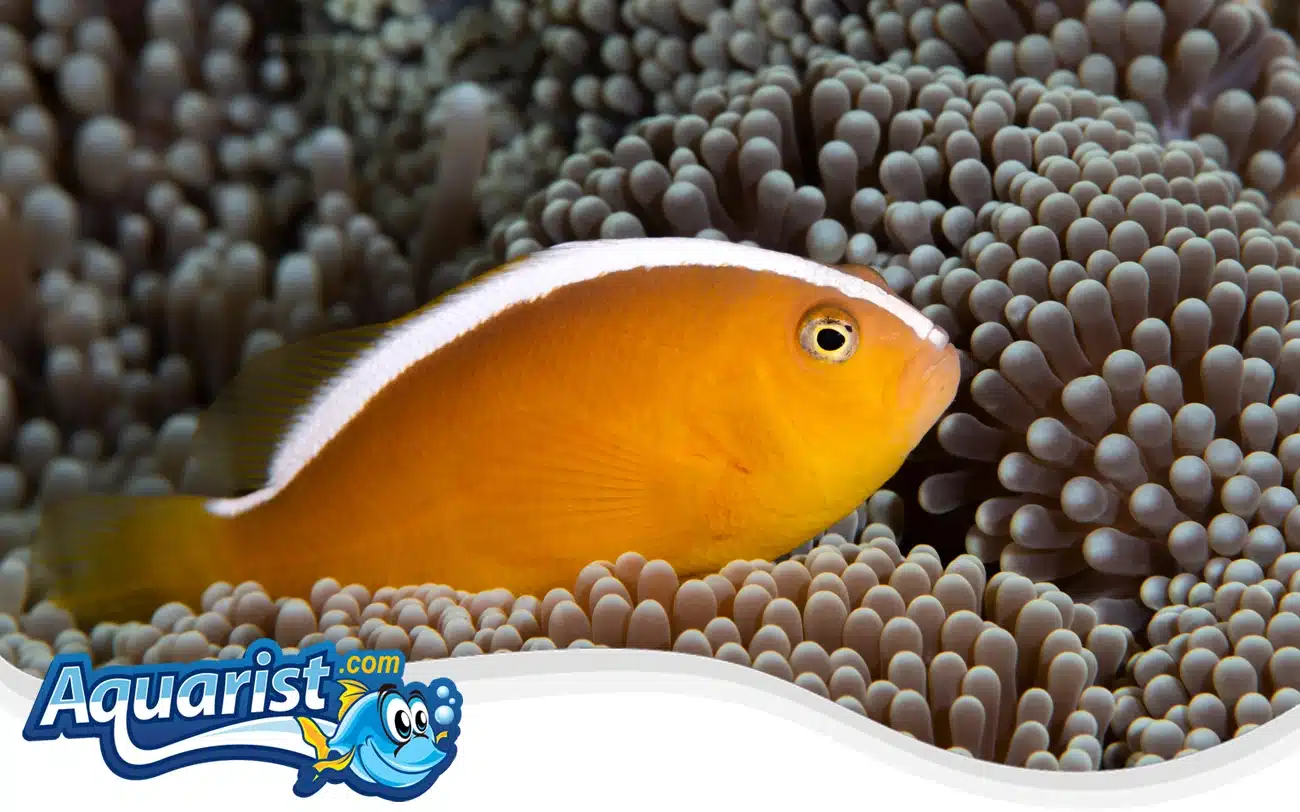
- Characterized by its bright orange body with a distinctive white stripe running from its snout to its dorsal fin.
- A relatively peaceful species that thrives in symbiotic relationships with sea anemones.
- Popular among marine aquarists for its vibrant coloration and hardy nature.
Feeding
- Omnivorous, primarily feeding on planktonic organisms and small invertebrates.
- Readily consumes high-quality flakes, pellets, and frozen foods such as mysis and brine shrimp.
- A balanced diet with occasional enriched foods promotes strong immunity and coloration.
- Multiple feedings throughout the day support active metabolism and growth.
Habitat
- Inhabits warm, shallow reef environments with abundant coral cover.
- Prefers stable water conditions with gentle to moderate water flow.
- Thrives in aquariums featuring live rock and host anemones such as Heteractis crispa.
- Adapts well to both natural reef tanks and fish-only setups.
Fish Care
- Recommended water temperature: 74-82°F (23-28°C).
- Ideal pH: 8.1–8.4, with a salinity range of 1.025–1.026 (about 33–35 ppt).
- Resilient but benefits from consistent water quality and proper filtration.
- Routine water changes help prevent stress and maintain overall health.
- Providing an anemone or rock formations enhances comfort and reduces stress.
Compatibility
- Generally peaceful but may become territorial when hosting an anemone.
- Compatible with other reef-safe species like tangs, wrasses, and gobies.
- Should not be kept with highly aggressive or predatory fish.
- Best housed in pairs or small groups introduced at the same time.
Aquarium Behavior
- Active yet cautious, often staying close to its host anemone or rock formations.
- Forms strong pair bonds and exhibits interesting social behaviors.
- May attempt to host in soft corals or artificial structures if an anemone is unavailable.
- Providing open swimming areas and secure hiding spots encourages natural movement and interaction.
Breeding
Want to breed Orange Skunk Clownfish? See our Breeding Clownfish guide, covering pair setup, spawning, egg care and raising the larvae to juveniles.
Read the guideFrequently Asked Questions
What is an Orange Skunk Clownfish?
Amphiprion sandaracinos is a pale-orange clownfish with one white stripe from its nose along the top of its back.
What is the difference between the Orange Skunk and the Pink Skunk Clownfish?
The Orange Skunk has only the white stripe along its back. The Pink Skunk also has a thin white bar behind its eyes.
How big does an Orange Skunk Clownfish get?
It reaches about 4 in (10 cm).
What size tank does an Orange Skunk Clownfish need?
At least 30 gallons (114 L) with plenty of hiding places.
Does an Orange Skunk Clownfish need an anemone?
No. In the wild it hosts Stichodactyla mertensii and Heteractis crispa, but an anemone is optional in an aquarium.
Is the Orange Skunk Clownfish peaceful?
Yes. It is rated peaceful.
What does an Orange Skunk Clownfish eat?
It is an omnivore. Feed mysis, brine shrimp, marine pellets and flakes.
Is the Orange Skunk Clownfish reef safe?
Yes, it is fully reef safe.
Is the Orange Skunk Clownfish good for beginners?
Yes. It is rated beginner-level and is hardy once settled.
Where does the Orange Skunk Clownfish come from?
It lives in the western Pacific, from Christmas Island and Western Australia north to the Philippines, Taiwan and the Ryukyu Islands.