
Overview
- Native to the Indo-Pacific, frequently found in shallow coastal waters, coral reefs, and mangrove estuaries.
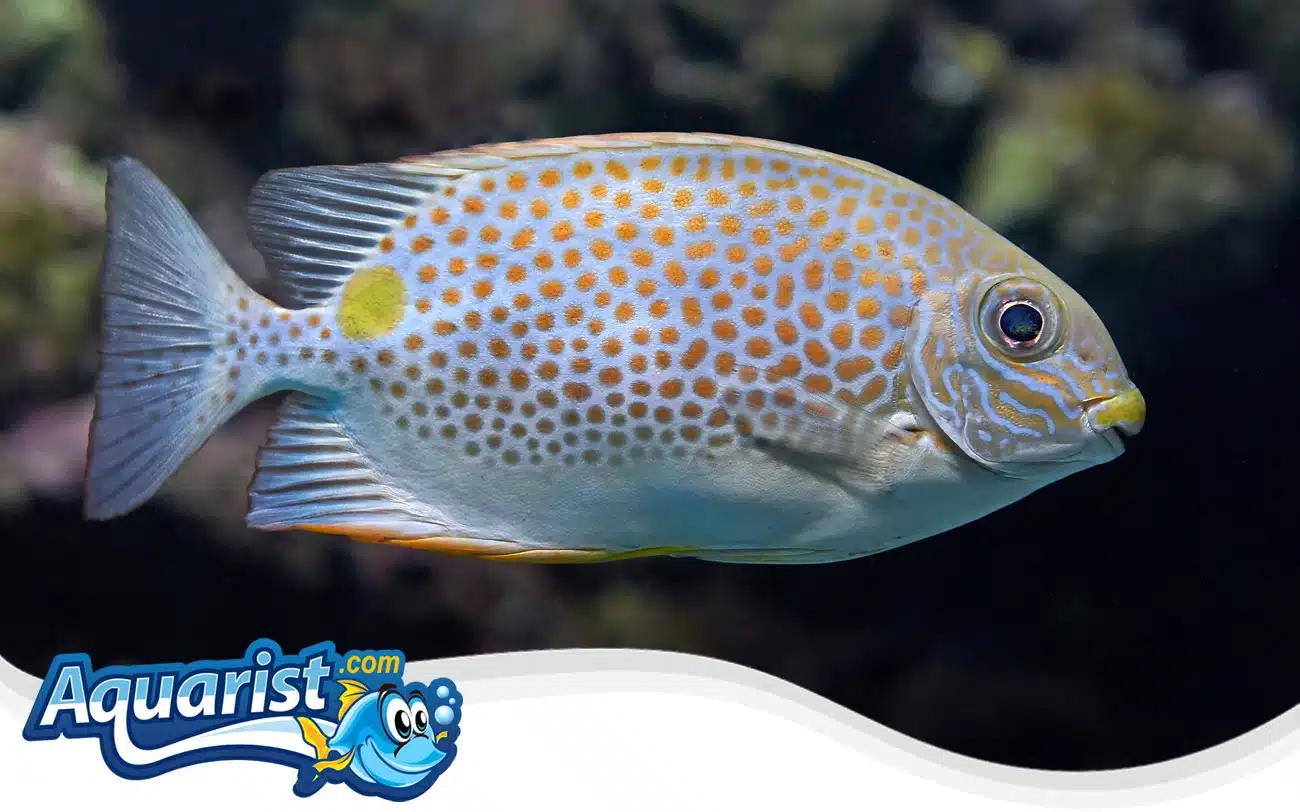
- Recognized for its distinctive orange-spotted body and silvery base color, giving it a striking appearance.
- A peaceful and hardy species that adapts well to aquarium life, provided with proper care.
- Possesses venomous dorsal spines that can cause a painful sting if mishandled.
- Best suited for aquariums with ample swimming space, live rock formations, and stable water conditions.
Feeding
- Herbivorous, primarily grazing on algae, seagrass, and marine plant material in the wild.
- Thrives on a diet of seaweed, spirulina, algae-based pellets, and frozen herbivore preparations.
- Helps control nuisance algae growth in aquariums by constantly grazing.
- Should be fed multiple times daily to support energy levels and promote healthy digestion.
- A diet rich in plant-based nutrients enhances coloration and supports a strong immune system.
Habitat
- Prefers reef-associated environments with moderate water currents and abundant plant life.
- Often seen foraging along coral reefs, rocky outcroppings, and seagrass beds.
- Aquarium setups should include live rock to provide natural grazing areas and hiding spots.
- Requires stable water parameters and high-quality filtration to maintain optimal water conditions.
- Providing a spacious tank encourages active swimming and natural foraging behaviors.
Fish Care
- Optimal water temperature: 74-80°F (23-27°C) to ensure healthy metabolic function.
- Preferred pH range: 8.1–8.4, with a salinity level of 1.025–1.026 (about 33–35 ppt).
- Requires regular water changes and consistent maintenance to prevent excess algae growth.
- Reef-safe but may nip at soft corals if not provided with sufficient plant-based food sources.
- Providing an enriched diet and structured habitat ensures a stress-free and active fish.
Compatibility
- Peaceful and well-suited for community reef tanks with other non-aggressive species.
- Compatible with tangs, angelfish, wrasses, and other herbivorous or semi-aggressive fish.
- Should not be housed with overly aggressive species that may cause stress.
- Best kept in environments where it has access to ample grazing surfaces.
- Providing multiple rock formations and swimming space ensures a balanced tank dynamic.
Aquarium Behavior
- An active and social swimmer that enjoys grazing on algae and plant matter.
- Frequently seen exploring rock formations and interacting peacefully with tankmates.
- More confident in a well-established aquarium with stable environmental conditions.
- Providing a structured environment with hiding areas encourages natural behaviors.
- Over time, it may become accustomed to its caretaker and actively engage during feeding sessions.
Frequently Asked Questions
What other names does the Orange-Spotted Spinefoot have?
Other common names include Yellow Blotch Rabbitfish, Orange Spotted Foxface Rabbitfish and Gold Saddle Rabbitfish.
What does an Orange-Spotted Spinefoot look like?
It has a brown body covered in orange spots, with a yellow false eye near the tail to confuse predators.
How big does an Orange-Spotted Spinefoot get?
Our page lists up to about 18 in (46 cm).
What size tank does an Orange-Spotted Spinefoot need?
At least 125 gallons (473 L) with plenty of open swimming space.
Is the Orange-Spotted Spinefoot venomous?
Yes. Its dorsal spines are venomous and raised when it is disturbed, so take care when handling it.
Is the Orange-Spotted Spinefoot reef safe?
With caution. Rabbitfish are generally reef safe when well fed, but hungry fish may nip some LPS and soft corals.
Can it live with other rabbitfish?
It does not get along with other rabbitfish, though it can be kept in pairs and with more aggressive fish.
What does an Orange-Spotted Spinefoot eat?
Offer algae sheets and other foods made for algae eaters. It feeds on benthic algae in the wild.
Can the Orange-Spotted Spinefoot tolerate brackish water?
It lives on murky inshore reefs among mangroves, tolerates or even prefers lower salinity, and adults move in and out of rivers with the tide.
Is the Orange-Spotted Spinefoot active at night?
Unlike other rabbitfish, it is reported to be active at night.