
Overview
- Native to the Indo-Pacific, commonly found in coral reefs, lagoons, and rocky coastal areas.
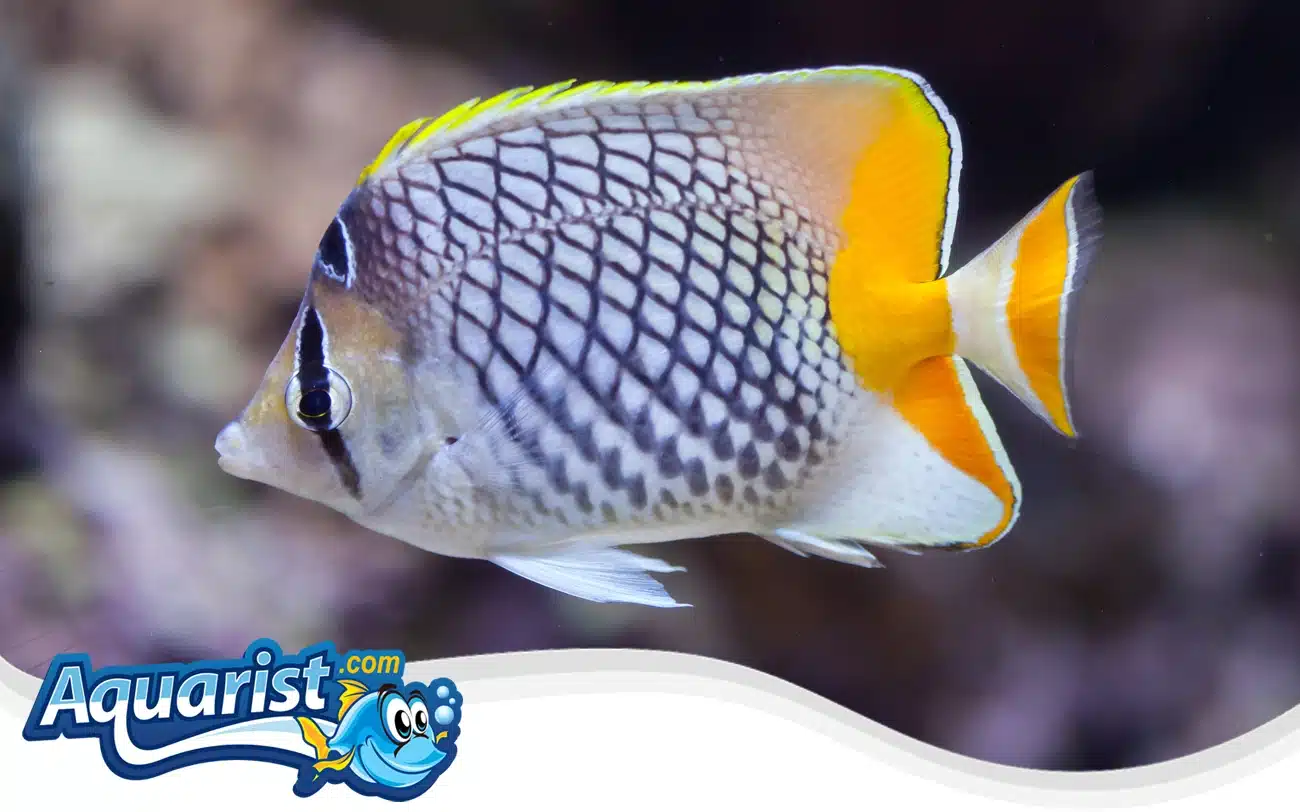
- Easily identified by its pearl-like scales with a lattice pattern and a striking yellow tail.
- A hardy species that adapts well to captivity when provided with proper water conditions.
- Often seen in pairs or small groups in the wild, indicating social behavior.
- Best suited for an established marine aquarium with stable water conditions and live rock.
Feeding
- Omnivorous, feeding on coral polyps, algae, and small invertebrates in its natural habitat.
- Thrives on a diet that includes sponge-based foods, frozen mysis shrimp, and high-quality marine pellets.
- Readily adapts to prepared foods but benefits from a mix of fresh and frozen meals.
- Multiple small feedings per day ensure proper digestion and nutrient intake.
- A well-balanced diet enhances coloration, immunity, and overall vitality.
Habitat
- Prefers coral-rich reef environments with moderate water currents.
- Commonly found near reef edges and sheltered areas where food sources are abundant.
- Aquarium setups should include live rock to support natural grazing and provide shelter.
- Requires high-quality filtration to maintain stable water parameters.
- Providing shaded areas alongside open swimming space helps replicate its natural environment.
Fish Care
- Optimal water temperature: 74-80°F (23-27°C) to support overall health.
- Preferred pH range: 8.1–8.4, with a salinity level of 1.025–1.026 (about 33–35 ppt).
- Requires stable water quality with regular maintenance and water changes.
- Not fully reef-safe, as it may nip at corals and sessile invertebrates.
- Providing live rock enhances grazing opportunities and supports natural behaviors.
Compatibility
- Generally peaceful but may become territorial with other butterflyfish.
- Compatible with tangs, angelfish, and other non-aggressive marine fish.
- Not ideal for reef tanks due to its potential to graze on coral polyps.
- Should be housed with similarly sized fish to prevent competition for food.
- Providing adequate space and rock formations minimizes potential territorial disputes.
Aquarium Behavior
- An active and inquisitive species that enjoys exploring its environment.
- Frequently seen grazing on rock surfaces and interacting with other tankmates.
- May take time to acclimate to captivity but becomes more confident with proper care.
- Providing live rock encourages natural foraging behavior and enhances environmental engagement.
- Over time, it may recognize its caretaker and show curiosity, particularly during feeding sessions.
Frequently Asked Questions
How do I recognize a Pearlscale Butterflyfish?
It has a pearly white body covered in a black crosshatch pattern, with orange toward the rear of the dorsal and anal fins and sickle-shaped orange bars on the tail.
How is it different from the Mertensii Butterflyfish?
The Pearlscale has a true net-like crosshatch pattern and a white-rimmed dark oval spot behind the eye band, while lookalikes such as the Mertensii show a V-shaped chevron pattern.
How big does it get?
It reaches up to about 5.5 in (14 cm) standard length (measured without the tail).
What size tank does it need?
Our page recommends at least 75 gallons (284 L) with other peaceful fish.
What is its natural habitat?
Adults live on clear coastal to outer reef slopes and drop-offs around staghorn corals, usually deeper than about 50 ft (15 m).
Is it found alone or in pairs?
It occurs singly or in pairs and forms pairs to breed.
What does it eat in the wild?
It feeds on small bottom-dwelling invertebrates and algae.
What should I feed it in an aquarium?
Offer a mix of meaty frozen, freeze-dried, fresh or flake foods, plus regular vegetable foods and vitamin supplements.
Is it safe with corals?
Our page rates it reef safe with caution. It is not considered reef safe, so watch it closely around corals and invertebrates.
Can I keep more than one?
It can live with others of its own species if they are all added to the tank at the same time.