
Overview
- Native to the Hawaiian Islands, commonly found in rocky reefs and deeper reef slopes.
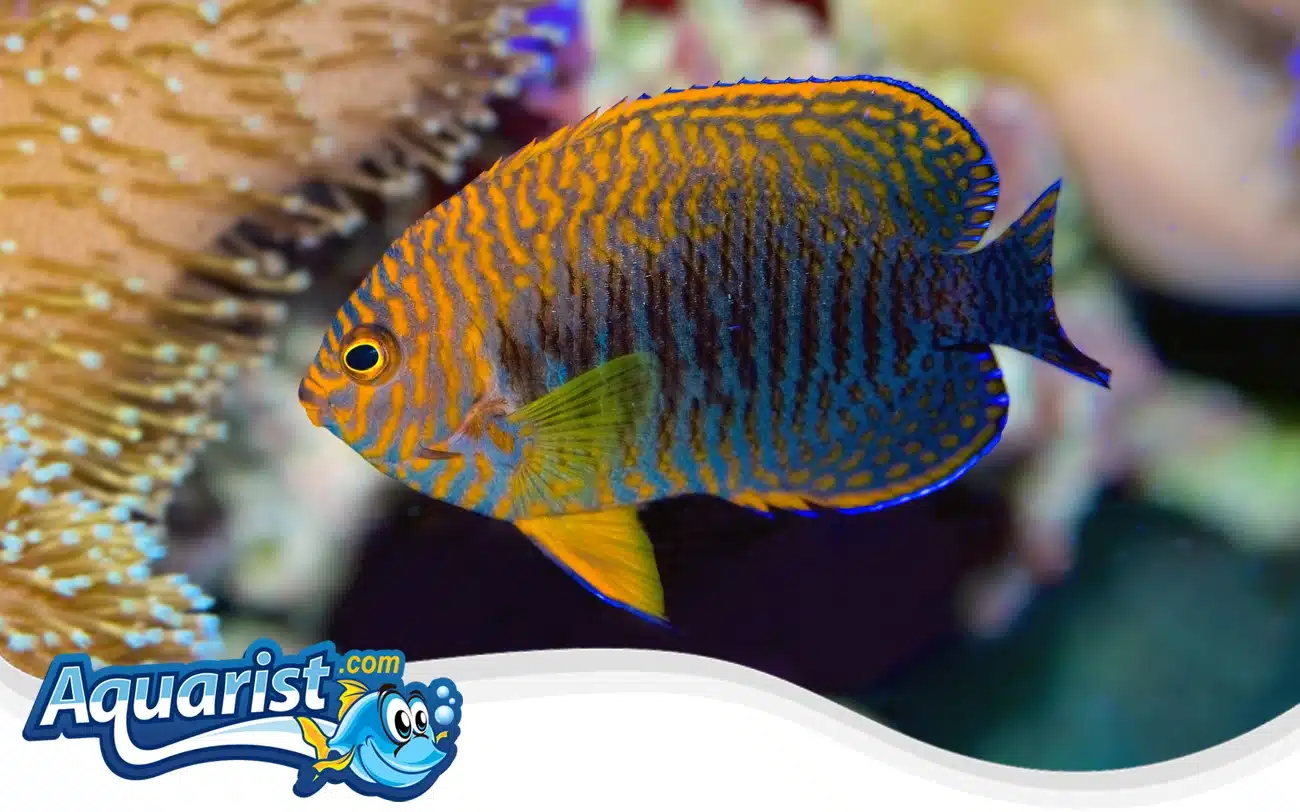
- Recognized for its striking blend of orange and blue hues with intricate patterns covering its body.
- A moderately active species that tends to stay near rock structures and caves.
- Can be territorial, particularly toward other dwarf angelfish, requiring careful tankmate selection.
- Best suited for a well-established marine aquarium with ample hiding spots and live rock for grazing.
Feeding
- Omnivorous, feeding on algae, sponges, and small invertebrates in the wild.
- Accepts high-quality marine pellets, frozen foods, and algae-based diets in captivity.
- Providing sponge-based foods is crucial for maintaining long-term health and vibrant coloration.
- Multiple small feedings per day ensure sustained energy and proper nutrition.
- A varied diet promotes a strong immune system and prevents malnutrition.
Habitat
- Prefers reef environments with rocky outcrops and caves for shelter.
- Thrives in stable water conditions with moderate to strong water movement.
- Aquarium setups should include live rock formations to encourage grazing and natural behavior.
- Requires a well-maintained marine tank with high water quality to minimize stress.
- Providing shaded areas and multiple caves helps reduce aggression and promotes security.
Fish Care
- Optimal water temperature: 74-80°F (23-27°C) to support overall health.
- Preferred pH range: 8.1–8.4, with a salinity level of 1.025–1.026 (about 33–35 ppt).
- Requires efficient filtration and regular water changes to maintain water quality.
- Introducing it to an established aquarium with live rock helps ease the acclimation process.
- Providing a structured environment with caves and crevices encourages natural behaviors.
Compatibility
- Semi-aggressive, particularly towards other dwarf angelfish and similarly sized fish.
- Compatible with tangs, wrasses, and other semi-aggressive reef fish.
- Not entirely reef-safe, as it may nip at soft corals and sessile invertebrates.
- Should not be housed with overly aggressive species that could cause stress or outcompete it for food.
- Providing ample swimming space and defined territories helps minimize territorial behavior.
Aquarium Behavior
- A somewhat shy species that prefers to stay close to rock formations.
- Often seen grazing on algae and darting in and out of caves.
- Can become territorial in smaller aquariums or when housed with similar species.
- Providing live rock structures and a well-structured tank setup supports natural behaviors.
- Over time, it may become more comfortable with its caretaker and exhibit interactive behaviors, especially during feeding.
Frequently Asked Questions
What is Potter's Angelfish?
Centropyge potteri is a dwarf angelfish found only in Hawaii. It has an orange body covered with fine wavy blue-black lines.
How big does Potter's Angelfish get?
It reaches about 4 in (10 cm).
What size tank does Potter's Angelfish need?
At least 70 gallons (265 L) with lots of live rock.
Is Potter's Angelfish reef safe?
It is reef safe with caution. It may nip LPS corals and clam mantles.
What does Potter's Angelfish eat?
It eats algae and detritus in the wild. Feed spirulina, nori, angelfish formula and frozen mysis.
Why is Potter's Angelfish considered difficult?
It is rated advanced because it can be shy and slow to adapt. It also comes from deeper water and does best in cool, stable conditions.
How do Potter's Angelfish breed?
They spawn at dusk during the week before the full moon, mostly from December through May.
Do Potter's Angelfish live in pairs?
Yes. In the wild they live in monogamous pairs that share a home range.
Where is Potter's Angelfish found?
It is endemic to the Hawaiian Islands, on rock, coral and rubble reefs.
Is Potter's Angelfish aggressive?
It is semi-aggressive and should be the only dwarf angel in the tank.