
Overview
- Native to the Indo-Pacific region, typically found in outer reef slopes and drop-offs.
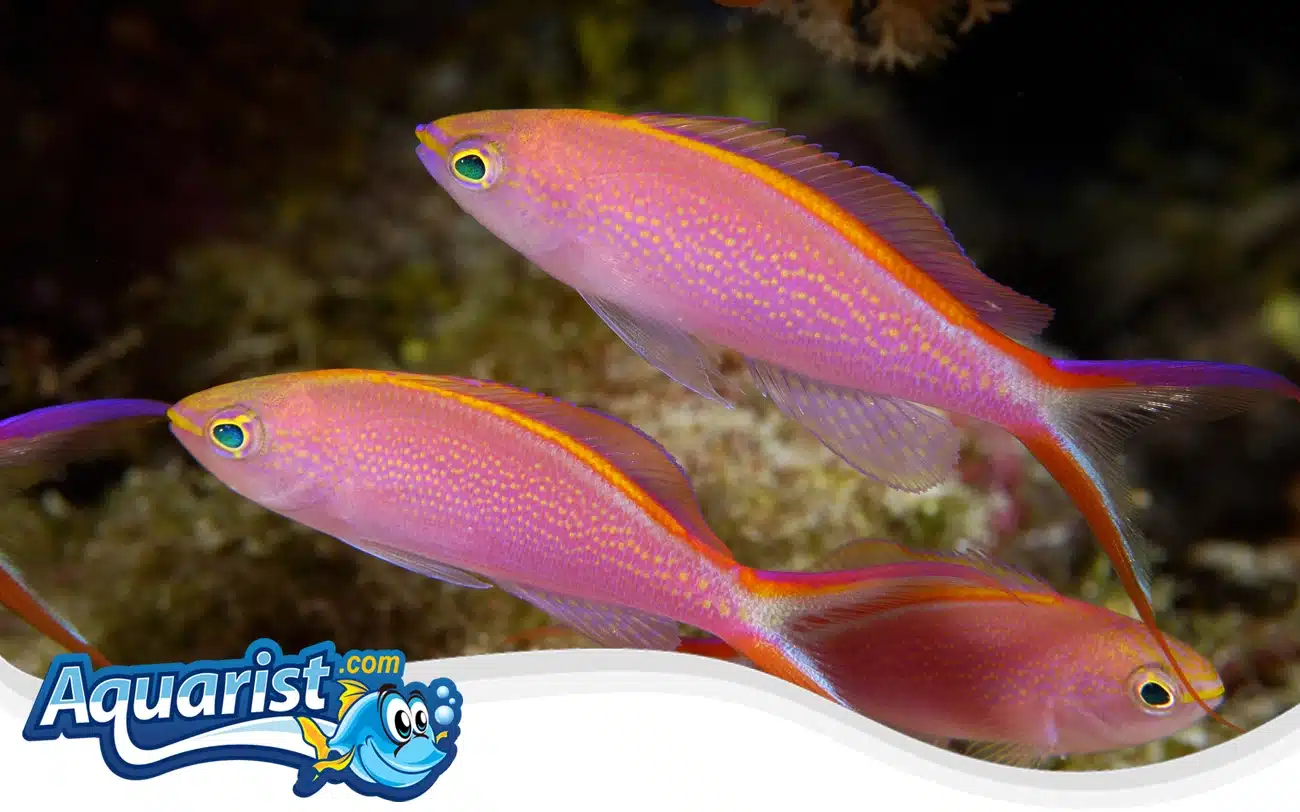
- Distinguished by its vivid pink and purple hues with subtle yellow highlights, especially in males.
- A peaceful, schooling species often seen swimming in the water column above coral formations.
- Best suited for intermediate to advanced aquarists due to its dietary and environmental needs.
Feeding
- Planktivorous; primarily feeds on zooplankton and other small marine organisms.
- In captivity, thrives on a varied diet of mysis shrimp, brine shrimp, finely chopped seafood, and specialized planktonic foods.
- Feed small amounts multiple times daily to replicate natural feeding behavior.
- Consistent, high-quality feeding is essential for health and vibrant coloration.
Habitat
- Requires a mature, well-established aquarium (minimum 70 gallons [265 L]) with excellent water quality and circulation.
- Open swimming space is important, along with structured live rock for refuge.
- Prefers subdued lighting and low-stress environments to thrive.
- Hiding places help reduce stress and support natural schooling behavior.
Fish Care
- Optimal water temperature: 72-78°F (22-26°C).
- pH level: 8.1–8.4, with a specific gravity of 1.025–1.026 (about 33–35 ppt).
- Requires stable water parameters; fluctuations can lead to stress or health issues.
- High water quality maintained through regular testing and water changes is vital.
Compatibility
- Peaceful and best kept in small groups with one male and multiple females.
- Compatible with other peaceful reef-safe species; avoid aggressive tank mates.
- Well-suited for reef aquariums, safe with corals and most invertebrates.
- May be shy around overly active or aggressive species, especially in smaller tanks.
Aquarium Behavior
- Schooling fish that prefers to swim in mid-water, especially in groups.
- Can be shy at first, but will become more confident in a stable, well-maintained environment.
- Thrives with plenty of space to swim and shelter to retreat to when needed.
- Displays bright coloration and natural behavior under ideal conditions.
Frequently Asked Questions
What does a Princess Anthias look like?
It is a rich sapphire-pink fish with a golden-yellow fleck on almost every scale, except those on the belly.
How big does a Princess Anthias get?
It reaches up to about 3.7 in (9 cm).
What size tank does a Princess Anthias need?
At least 70 gallons (265 L), with live rock caves plus open water. Keep plenty of surface area for good oxygenation.
Is the Princess Anthias hard to acclimate?
It can be. It is collected from water up to 228 ft (70 m) deep, finds shipping stressful and may be difficult to settle in quarantine.
What lighting does a Princess Anthias prefer?
It prefers low to moderate light at first but adapts to stronger reef lighting over time. Shaded overhangs give it somewhere dimmer to retreat.
What does a Princess Anthias eat?
It is a planktivore. Offer enriched frozen mysis and brine shrimp, with small portions of quality flake later, fed several times a day.
Does a refugium help a Princess Anthias?
Yes. A refugium growing copepods and amphipods gives it a steady supply of live food.
Should I keep Princess Anthias in a group?
It can be kept alone but does best in a small shoal of several fish. Large aggregations form in the wild.
When should I add a Princess Anthias to my tank?
Early. Add it before more active, territorial fish so it can settle with less stress, then keep it with peaceful tankmates.
Can a female Princess Anthias change into a male?
Yes. Anthias are hermaphrodites, and if the dominant male dies, the largest female can become a functioning male.