
Overview
- The Red Saddleback Clownfish is native to the eastern Indian Ocean, from the Andaman Sea to Sumatra and Java, in silty coastal waters and sheltered bays.
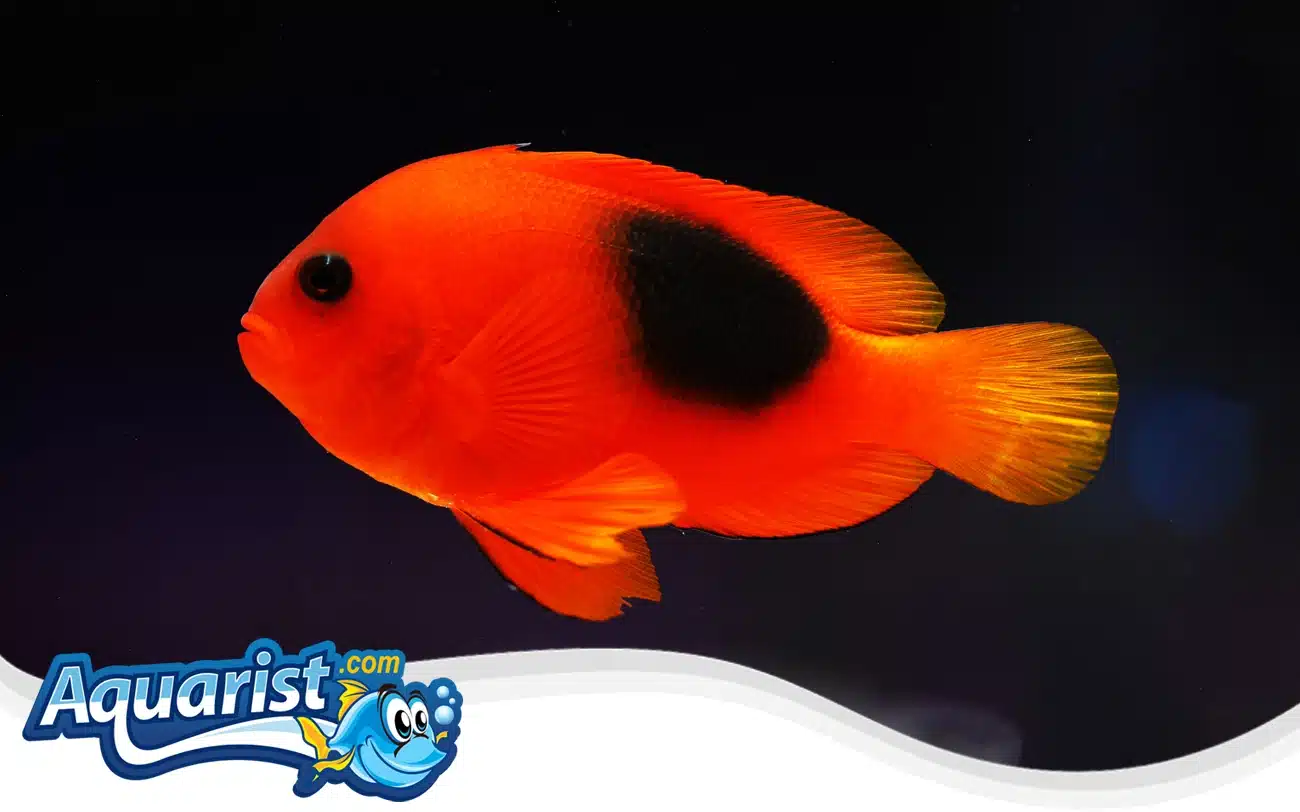
- Adults have a reddish-orange body and fins with a black saddle or spot on each side, and no white bars.
- Young juveniles can show two or three white bars, which disappear as the fish matures.
- Also known as the Saddle Anemonefish. Not to be confused with the Saddleback Clownfish (Amphiprion polymnus), a brown to yellow-orange fish with a white head bar and white saddle from the western Pacific.
- Territorial, and pairs defend their anemone or chosen cave.
Feeding
- Omnivorous diet, consuming plankton, algae, and small invertebrates.
- Readily accepts marine pellets, flakes, and frozen foods such as mysis shrimp and brine shrimp.
- Mix meaty frozen foods with a pellet or flake that contains algae.
- Two or three small feedings a day suit it better than one large one.
Habitat
- Lives in silty coastal waters and sheltered bays, often where visibility is low, at about 7-50 ft (2-15 m).
- In the wild it lives in bubble-tip anemones (Entacmaea quadricolor) and sebae anemones (Heteractis crispa). If you want to add a host, the bubble-tip is much easier to keep than the sebae anemone.
- Prefers stable water conditions with moderate water movement.
- Thrives in aquariums with live rock formations, with or without an anemone.
- Well-suited for community reef tanks but may become territorial in smaller spaces, especially around its anemone.
Fish Care
- Optimal water temperature: 74-82°F (23-28°C).
- Ideal pH: 8.1-8.4, with a specific gravity of 1.023-1.026 if you keep a host anemone (1.020-1.025 is fine in a fish-only tank).
- Generally hardy once settled, especially captive-bred fish, which makes it a reasonable choice for beginners.
- Some keepers report that it is unusually sensitive to copper-based medications, so use a copper-free treatment where one is available.
- Choose captive-bred fish over wild-caught ones if you can find them.
- Regular water changes and proper filtration help maintain long-term health.
- Hiding spots, and an anemone if you want one, give it a secure base.
Compatibility
- Can be aggressive, especially toward other clownfish species.
- Compatible with peaceful to semi-aggressive fish of similar size, such as gobies, blennies, and small wrasses. Tangs and angelfish need a much bigger aquarium than this fish alone.
- Should not be housed with highly aggressive species or larger predatory fish.
- Best kept singly or as a mated pair to avoid aggression.
Aquarium Behavior
- Active swimmer that stays close to its anemone or chosen cave.
- Defends its territory and may chase tank mates that come too close.
- Usually found in pairs in the wild, and a pair stays together in the aquarium.
- Pairs lay eggs on a hard surface, and the male guards and fans them until they hatch.
Breeding
Want to breed Red Saddleback Clownfish? See our Breeding Clownfish guide, covering pair setup, spawning, egg care and raising the larvae to juveniles.
Read the guideFrequently Asked Questions
What else is the Red Saddleback Clownfish called?
It is also called the Saddle Anemonefish or Red Saddleback Anemonefish. It is a different species from the Saddleback Clownfish (Amphiprion polymnus).
What does an adult look like?
A reddish-orange body and fins with a black saddle or spot on each side.
Do juveniles look different?
Yes. Small juveniles can have 2 or 3 white bars, which disappear as they mature.
How do you tell it apart from the Tomato Clownfish?
Adults have no white head bar. That separates it from the similar Tomato Clownfish (A. frenatus), Cinnamon Clownfish (A. melanopus), and Australian Clownfish (A. rubrocinctus).
Which anemones does it live in?
The bubble-tip anemone (Entacmaea quadricolor) and the sebae anemone (Heteractis crispa).
How big does it get?
Up to about 5 in (13 cm).
What size tank does it need?
At least 30 gallons (114 L) for one fish or a pair.
What habitat does it live in?
Adults live in silty coastal waters and protected bays at about 7-50 ft (2-15 m).
How does it breed?
It forms pairs and lays eggs that stick to a hard surface, and the male guards and fans them. It has been bred in captivity.
Is it usually seen alone?
No. It is usually found in pairs.