
Overview
- Found in the Western Pacific Ocean, particularly in deep reef environments with sandy substrates.
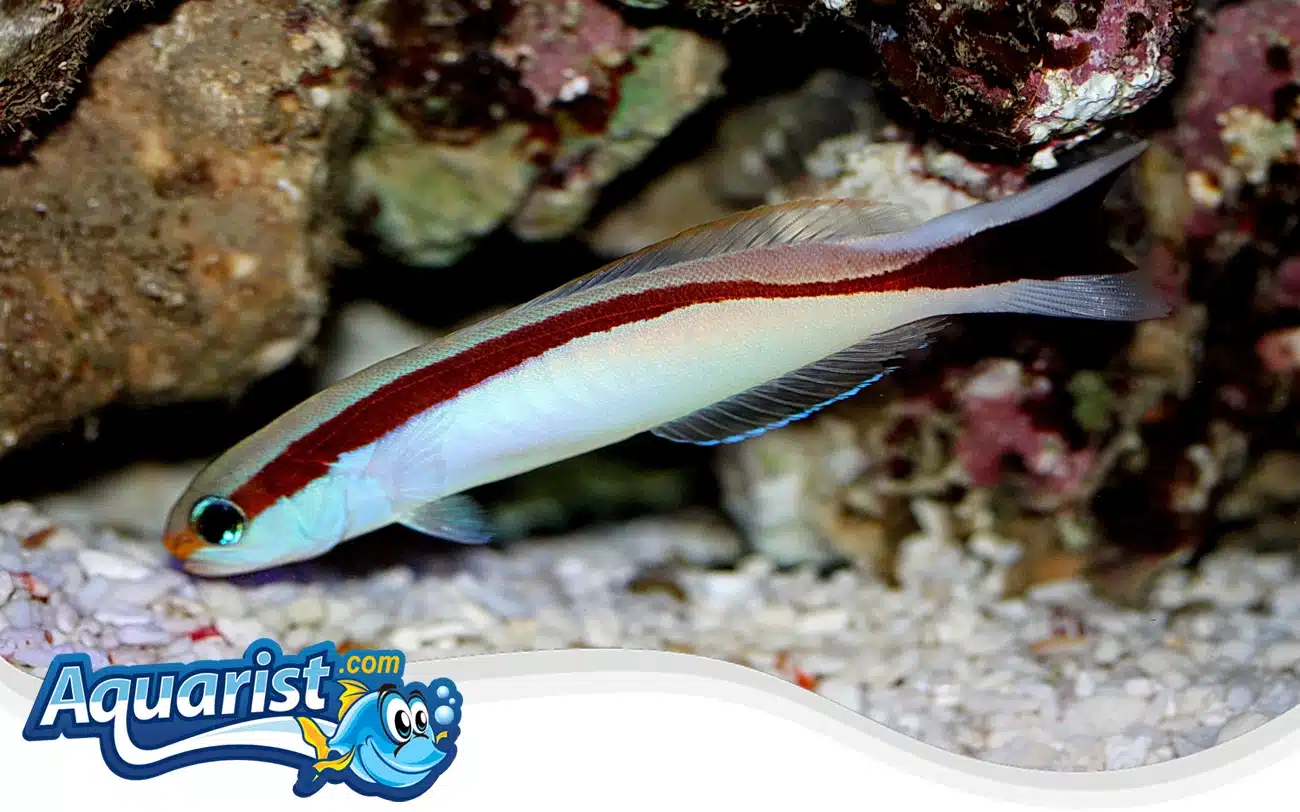
- Recognized for its elegant elongated body, often displaying shades of light blue and pink.
- A peaceful and elusive species, frequently seen darting into burrows when threatened.
- Due to its shy nature, it thrives best in a well-established marine aquarium with minimal aggression.
Feeding
- Primarily a zooplankton feeder, consuming small crustaceans and microscopic organisms in the wild.
- Accepts a variety of prepared foods in captivity, including frozen mysis shrimp, enriched brine shrimp, and finely chopped seafood.
- Small, frequent meals help mimic its natural feeding habits and ensure proper nutrition.
- Supplementing with high-quality pellets or flakes can enhance overall health and coloration.
Habitat
- Prefers deep-water reefs with soft, sandy areas where it can construct burrows.
- Requires a tank setup with fine substrate to accommodate its natural digging behavior.
- Best suited for aquariums with stable water conditions and moderate water flow.
- Hiding spaces and gentle lighting can help reduce stress and encourage more natural activity.
Fish Care
- Optimal water temperature: 74-82°F (23-28°C).
- Ideal pH level: 8.1-8.4, with a specific gravity of 1.023-1.026.
- Highly sensitive to water quality fluctuations; pristine conditions are necessary.
- Best introduced into a stable, mature aquarium to minimize acclimation stress.
Compatibility
- Extremely peaceful; ideal for community tanks with other non-aggressive species.
- Best kept in pairs or small groups if the aquarium is large enough.
- Avoid housing with aggressive fish that may intimidate or outcompete it for food.
Aquarium Behavior
- Shy by nature, often retreating to burrows when startled.
- Becomes more confident over time with a stable and calm environment.
- Can form symbiotic relationships with other burrow-dwelling fish in the wild.
- Requires a well-secured aquarium lid, as it is prone to jumping when frightened.
Frequently Asked Questions
Is the Skunk Tilefish a wrasse?
No. Hoplolatilus marcosi is a sand tilefish in the family Malacanthidae. It is also called the Redstripe, Redback or Marcos' Tilefish.
How big does the Skunk Tilefish get?
About 5 in (12 cm).
What size tank does a Skunk Tilefish need?
At least 75 gallons (284 L), with open swimming space and a sand and rubble area for its burrow.
Does the Skunk Tilefish need a lid?
Yes. It is an excellent jumper when startled, so the tank needs a tight-fitting lid with no gaps.
What does the Skunk Tilefish eat?
It feeds on zooplankton in the wild. Offer frozen mysis, enriched brine shrimp and finely chopped seafood in several small meals a day.
Is the Skunk Tilefish reef safe?
Yes. It does not harm corals, though it may eat very tiny invertebrates.
Can Skunk Tilefish be kept in pairs?
Yes. It often lives in pairs in the wild and does well as a pair introduced together.
What tank mates suit a Skunk Tilefish?
Calm fish like gobies, cardinalfish, firefish and peaceful wrasses. Aggressive tank mates will keep it hiding.
Where is the Skunk Tilefish found?
In the western Pacific, including Indonesia, Palau, the Philippines, Papua New Guinea and the Solomon Islands, usually in deep water near reef drop-offs.
Why does the Skunk Tilefish build mounds?
It piles up coral rubble into mounds over its burrow, which it retreats into when threatened. Secure rockwork before adding sand, as it may dig underneath.